
585.204.6770
sale@sanblueplastics.com
Your Source for Trays!
10 Best Ductile Iron Manhole Cover Suppliers Worldwide
Choosing a ductile iron manhole cover is a practical decision with consequences below street level. A poorly seated cover can rock under passing traffic, while a sound frame-and-cover fit helps reduce movement and noise. Details matter. Joseph M. Juran, a leading quality expert, defined quality as “fitness for use.” For municipal buyers, that idea means checking more than a supplier’s catalogue or quoted price.
This guide introduces 10 suppliers worldwide and the factors worth comparing: load-rating options, material and coating details, test documentation, manufacturing capacity, customization, and delivery support. Ask how each supplier verifies dimensions and load performance. Check whether drawings match the intended frame, road conditions, and installation method. A polished product photo cannot answer those questions. Neither can a low price.
Supplier reach and product ranges change, so this list should be treated as a starting point, not a final endorsement. Some buyers may value local technical support more than a broad export network. Others may need nonstandard sizes, and that can complicate procurement. There is no perfect shortlist. The right choice depends on the site, specification, and evidence each supplier can provide. Before ordering, confirm critical requirements directly with the manufacturer and the project engineer.
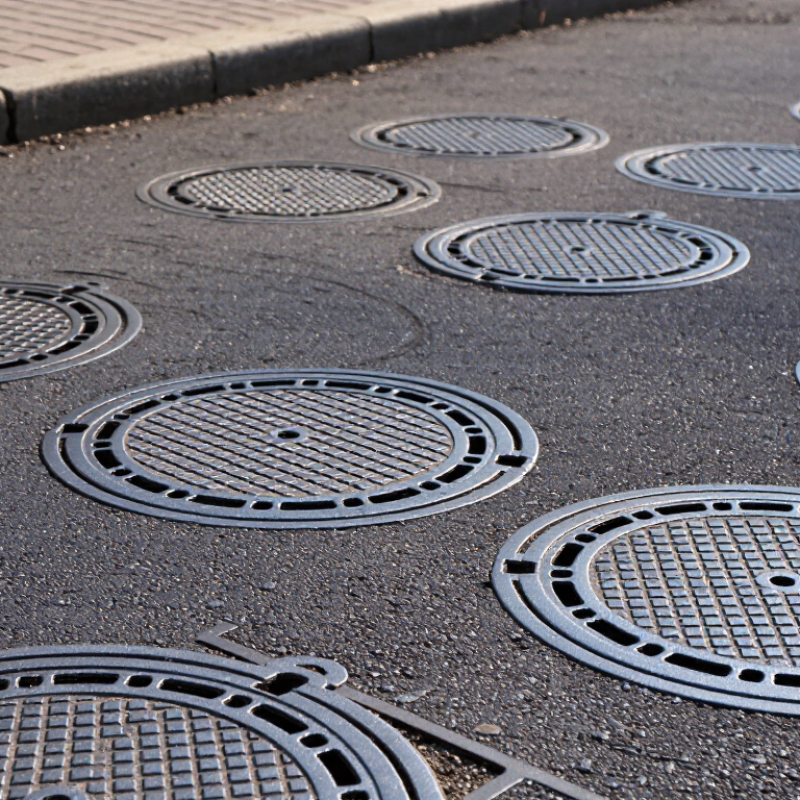
Understanding Ductile Iron Manhole Covers and Their Applications
ductile iron manhole covers are access components for buried water, sewer, drainage, and utility networks. Their graphite-rich structure helps them withstand repeated wheel loads while offering more toughness than brittle cast iron. Material grade matters: ASTM A536 Grade 65-45-12 specifies minimum tensile strength of 65 ksi, yield strength of 45 ksi, and elongation of 12%. These figures describe the material, not the performance of a complete installed cover. Details matter.
For roadways, the EN 124-2:2015 standard assigns class D400 a 400 kN test load, making it a common reference for covers in carriageways. Actual selection still depends on traffic, opening size, frame support, and local specification. On site, a stable frame bed helps prevent rocking; a poor fit can create the familiar clack under passing tires. Coatings can slow corrosion, but they do not replace inspection, especially where de-icing salts or wastewater exposure are present. One detail is easy to miss: a strong cover cannot compensate for a damaged frame or uneven seating. Standards provide a useful baseline, not a substitute for checking installation conditions.
10 Best Ductile Iron Manhole Cover Suppliers Worldwide – Understanding Ductile Iron Manhole Covers and Their Applications
A supplier-neutral guide to ten common supplier capability profiles and the product specifications buyers may encounter. Profiles are not named companies or a ranked supplier list.
| No. | Supplier capability profile | Typical product offering | Relevant load classes | Common applications | Useful procurement checks |
|---|---|---|---|---|---|
| 1 | Municipal infrastructure specialist | Ductile iron covers and frames in round or square formats; options may include lifting keys, hinges, and locking features. | EN 124-2: B125, C250, D400, as required by location | Footways, kerbside areas, streets, and municipal drainage networks | Confirm the specified EN 124 class, clear opening, frame depth, and compatibility with the installation detail. |
| 2 | Road and highway casting supplier | Heavy-duty covers and frames designed for roadway installation, often with anti-rocking or traffic-noise-reduction features. | Typically D400; E600 where the site design requires it | Carriageways, truck routes, and other trafficked areas | Check the applicable standard and test documentation; confirm seating, restraint, and frame support requirements. |
| 3 | Utility-network product supplier | Access covers in different clear-opening sizes, with solid or ventilated cover designs and utility-specific markings. | Selected according to installation location, commonly B125 to D400 | Water, wastewater, telecommunications, and other underground utility access points | Verify the opening dimensions, cover identification, safe lifting provisions, and any utility-owner requirements. |
| 4 | Drainage and surface-water specialist | Manhole covers and compatible gully gratings; products may be supplied with frames suited to drainage installations. | EN 124-2 class selected for the area; C250 or D400 may be specified near roads | Stormwater systems, drainage chambers, and roadside collection points | Check hydraulic or ventilation needs, frame fit, and the class required for the exact installation position. |
| 5 | North American specification-focused supplier | Ductile iron access covers and frames configured to project or municipal specifications. | Use the governing local specification; AASHTO M306 may apply to relevant castings | Municipal streets, utility systems, and public works projects | Confirm the project’s required standard, proof-load or design criteria, dimensions, and material documentation. |
| 6 | Industrial-site casting supplier | Robust covers and frames for installations exposed to frequent heavy vehicle or equipment traffic. | EN 124-2: E600 or F900 only where the site conditions and design call for these classes | Ports, industrial yards, freight areas, and airport-related pavements | Match the specified class to the actual traffic conditions; confirm the supporting structure is designed for the load. |
| 7 | Pedestrian-area and public-realm supplier | Compact covers, including options with recessed or patterned tops for integration with surrounding surfaces. | EN 124-2: A15 or B125, subject to location and design requirements | Pedestrian zones, landscaped areas, and footways | Check the required slip resistance, surface finish, opening method, and suitability for the planned paving build-up. |
| 8 | Lockable and security-feature supplier | Access covers with locking, bolting, or hinged arrangements, depending on the product design. | Class is determined by the installation location, not by the locking feature | Restricted-access utility chambers and public infrastructure installations | Confirm the lock type, authorized opening method, maintenance access, and required load class separately. |
| 9 | Low-noise and sealed-cover supplier | Products may include elastomeric seating or sealing elements intended to reduce movement, noise, or water ingress. | Selected for the site; commonly specified from B125 through D400 in urban settings | Urban streets, residential areas, and locations where cover movement or noise is a concern | Ask for details on gasket material, replacement, seating design, and any applicable test evidence. |
| 10 | Export and project-customization supplier | Made-to-order dimensions, markings, finishes, or packaging, subject to tooling and production capability. | Must be specified under the destination market’s applicable standard and project requirements | Infrastructure projects with non-standard dimensions, documentation, or delivery requirements | Approve drawings and samples; verify tolerances, test reports, traceability, coating requirements, and delivery terms. |
Load-class note: Under EN 124, classes include A15, B125, C250, D400, E600, and F900. The appropriate class depends on the installation location and applicable project requirements. EN 124-2 covers cast iron access covers and gratings; always confirm the governing standard and edition for the project.