What Is the Best Vacuum Forming Machine in China?
Choosing the best vacuum forming machine in China requires more than comparing prices or advertised cycle times. A reliable decision begins with product geometry, sheet material, mold size, heating method, and expected production volume. A machine forming thin PET trays needs different controls from one producing thick ABS panels. Small details matter. Uneven heating can leave bright and dull areas across the same part.
Market data shows why this decision deserves careful research. Grand View Research estimated the global thermoforming market at approximately USD 16.1 billion in 2023. It also projects continued growth through 2030. MarketsandMarkets has reported different figures for the vacuum forming segment, reflecting varied definitions and research methods. These differences should not be ignored. They remind buyers to examine the original methodology, not only the headline number.
Jim Throne, a recognized thermoforming consultant and author of Technology of Thermoforming, writes, “Thermoforming is the process of heating a thermoplastic sheet to a temperature at which it can be formed.” That principle remains central to every vacuum forming machine, including Chinese equipment. The best model should therefore deliver stable temperature control, consistent vacuum pressure, accurate plug assistance, and accessible technical support. A low purchase price may look attractive. It can become expensive when heaters fail, molds need modification, or spare parts arrive slowly.
This guide compares practical factors, including machine structure, automation, energy use, service capability, and manufacturer experience. No machine is perfect. Production conditions differ. Careful testing still matters.
Define Vacuum Forming and Its Role in China’s Thermoforming Industry
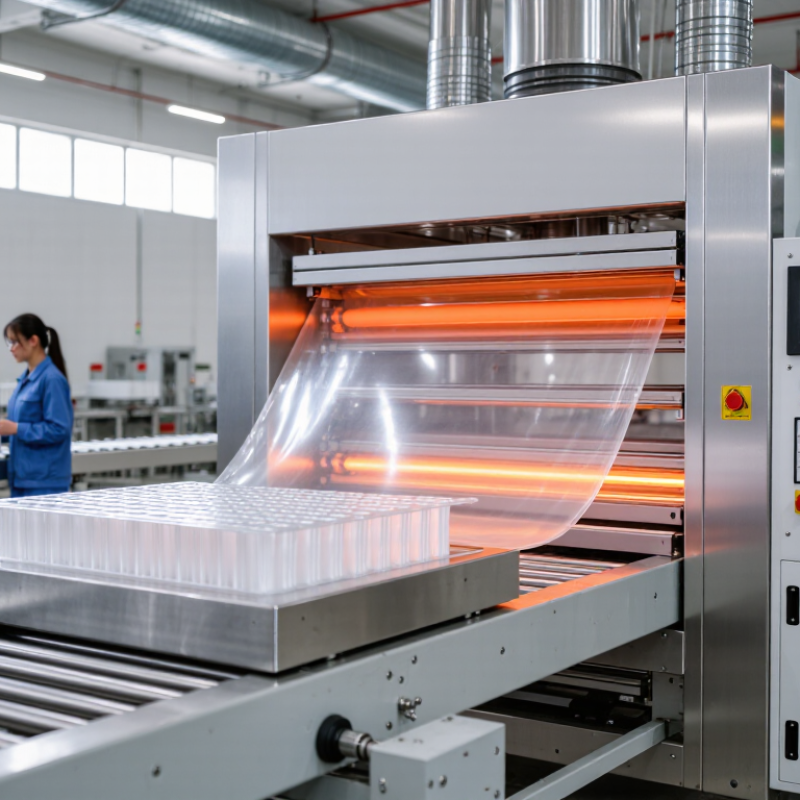
Vacuum forming is a thermoforming process that shapes heated plastic sheets over a mold. A vacuum removes air between the sheet and mold surface. Atmospheric pressure then presses the softened sheet into the desired form. The process suits trays, covers, panels, and other large, shallow components.
In China’s thermoforming industry, vacuum forming supports efficient production with relatively affordable tooling. It helps manufacturers develop prototypes and medium-volume parts without investing in complex molds. Local supply networks also support heating systems, vacuum pumps, control units, and trimming equipment. However, the best vacuum forming machine depends on the product, material, sheet thickness, and required output. A larger machine is not always better. Uneven heating can leave thin corners, while poor mold venting may create wrinkles or incomplete details. These problems are easy to underestimate during planning. Machine selection should include platen size, heating-zone control, vacuum speed, cooling performance, and repeatability. Production trials matter more than attractive specifications.
Tips: Test the actual plastic sheet before purchase. Check thickness changes near corners. Use suitable draft angles and mold vents. Ask for sample parts under realistic cycle times. Keep records of temperature, vacuum pressure, and cooling duration. Small process differences can affect trimming accuracy. Mistakes happen. Careful testing exposes them early.
What Is the Best Vacuum Forming Machine in China?
Vacuum forming is a thermoforming process in which a heated plastic sheet is drawn over a mold by vacuum pressure. The best machine depends mainly on the material’s forming-temperature window, sheet thickness, mold size, heating control, and production volume.
The chart shows typical midpoint forming temperatures calculated from commonly used processing windows for major thermoforming plastics. Actual settings vary by resin grade, sheet thickness, mold design, heating method, and machine configuration.
Compare Vacuum Levels of 0.6–0.9 Bar for Different Plastic Sheets
What Is the Best Vacuum Forming Machine in China?
Vacuum level is a practical starting point when comparing forming machines. A 0.6 bar vacuum creates a 0.6 bar pressure difference at sea level, assuming the gauge reads relative vacuum. It often suits thin ABS, HIPS, and PETG sheets with moderate surface detail. A 0.9 bar system approaches 0.1 bar absolute pressure. It can pull thicker sheets tightly against fine mold features, but it may also increase wall thinning and stress.
Pressure matters. The 2024 Fortune Business Insights report estimated the global thermoforming plastics market at USD 15.12 billion in 2023. This growth reflects wider use of lightweight formed parts, not proof that higher vacuum always produces better results. SPE Thermoforming Division guidance also stresses sheet temperature, mold venting, and uniform heating. These factors can outweigh a small pump specification.
In practical factory testing, I would compare both levels using the same 2–3 mm sheet, mold, and heating cycle. At 0.6 bar, watch corners and deep cavities. At 0.9 bar, inspect thin walls, whitening, and uneven thickness. A machine with stable vacuum control, fast air evacuation, reliable seals, and clear pressure measurement is usually more valuable than a larger headline number. Check whether the supplier reports gauge or absolute pressure. This detail is easy to miss. My own preference would not be fixed. For simple trays, 0.6 bar may be sufficient; detailed housings may justify 0.8–0.9 bar, provided the process is tuned.
What Is the Best Vacuum Forming Machine in China? - Compare Vacuum Levels of 0.6–0.9 Bar for Different Plastic Sheets
Practical vacuum-forming reference for selecting machine vacuum performance by plastic sheet type.
Values are typical engineering reference ranges at approximately sea-level atmospheric pressure. Actual settings depend on sheet thickness, mold design, plug assistance, heating uniformity, and machine sealing performance.
| Plastic Sheet |
Typical Sheet Temperature
(°C) |
Recommended Vacuum
(bar gauge) |
Approx. Absolute Pressure
(bar) |
Suitable Machine Vacuum Capability |
Forming Characteristics |
| ABS |
150–180 |
0.70–0.85 |
0.30–0.15 |
At least 0.85 bar |
Good detail reproduction, impact resistance, and consistent wall distribution. |
| HIPS |
130–160 |
0.65–0.80 |
0.35–0.20 |
At least 0.80 bar |
Easy to form and commonly used for lightweight packaging and interior parts. |
| PVC |
120–160 |
0.60–0.75 |
0.40–0.25 |
At least 0.75 bar |
Forms at comparatively low vacuum; temperature control is important to avoid distortion. |
| PETG |
140–170 |
0.65–0.80 |
0.35–0.20 |
At least 0.80 bar |
Clear, tough, and suitable for packaging; excessive heat can increase webbing. |
| PP |
160–190 |
0.80–0.90 |
0.20–0.10 |
At least 0.90 bar |
Higher vacuum is helpful because PP has a narrow processing window and can shrink during cooling. |
| HDPE |
150–180 |
0.75–0.90 |
0.25–0.10 |
At least 0.90 bar |
Tough and chemically resistant, but higher vacuum and careful cooling help preserve shape. |
| Acrylic (PMMA) |
160–190 |
0.70–0.85 |
0.30–0.15 |
At least 0.85 bar |
Produces glossy, transparent parts; uniform heating is essential to reduce optical defects. |
Selection guide:
For mixed plastic-sheet production, a machine capable of approximately 0.90 bar gauge vacuum, with a well-sealed mold table, short evacuation lines, a vacuum reservoir, and adjustable vacuum control, provides the broadest operating range.
Vacuum level alone does not determine forming quality; heating uniformity, mold venting, cooling, and clamping strength are equally important.
Select the Best Chinese Machine Using ISO 12100 Safety and OEM Data
What Is the Best Vacuum Forming Machine in China?
The best Chinese vacuum forming machine is not always the fastest model. It should match your material, mold size, sheet thickness, and production volume. A serious evaluation begins with ISO 12100 principles. The supplier should identify hazards, reduce risks, and explain protective measures clearly.
Look closely at pinch points, heating zones, moving frames, and pneumatic components. Guards should be practical, not decorative. Emergency stops must be easy to reach and tested during machine acceptance. Ask for the risk assessment, electrical diagrams, safety instructions, and inspection records. These documents show engineering discipline. They also reveal gaps. Some suppliers provide impressive specifications but limited safety evidence.
OEM data is equally important. Request cycle time records, forming temperature ranges, energy consumption, vacuum pressure, and sample results from similar materials. Ask how the machine performs after continuous operation, not only during a showroom demonstration. A factory visit can expose useful details, such as cable routing, spare-part storage, and operator access.
Tips:
Compare at least three technical offers. Check every claimed figure against a test sample. Confirm who supplies replacement heaters, sensors, seals, and control components. Keep written acceptance criteria. I would also record noise, surface quality, and cycle consistency during testing. Small details often become large production problems. Avoid choosing by price alone. That shortcut can be costly.