
585.204.6770
sale@sanblueplastics.com
Your Source for Trays!
Choosing China’s best Rubber Slitter Cutting Machine manufacturer takes more than comparing prices or glossy production videos. The right machine must handle your rubber compound, roll width, thickness, and target tolerance without leaving ragged edges. Ask for a trial using your own material. Watch the blade track through the sheet. Check the cut edge, repeatability, guarding, and changeover time. Small details matter.
Industry reports provide useful context, but not a shortcut to a machine decision. The International Rubber Study Group’s World Rubber Industry Outlook tracks global rubber supply and demand; it does not rank slitter manufacturers or verify cutting accuracy. That distinction matters. A growing rubber market does not automatically mean every factory needs the same machine. For a practical benchmark, manufacturing expert Taiichi Ohno is widely associated with the principle, “Where there is no standard, there can be no improvement.” Applied here, it means defining acceptable cut width, edge quality, and throughput before comparing suppliers. His principle is not specific to rubber slitters, but it is relevant to disciplined equipment selection.
This guide examines Chinese manufacturers through measurable questions: Can they document test results? Do they explain blade options and maintenance? Can they provide installation support and spare parts? Request evidence, not promises. A supplier may look convincing online and still struggle with your material. That is the uncomfortable part. Manufacturer claims deserve verification, and the available public data rarely settles the question on its own.
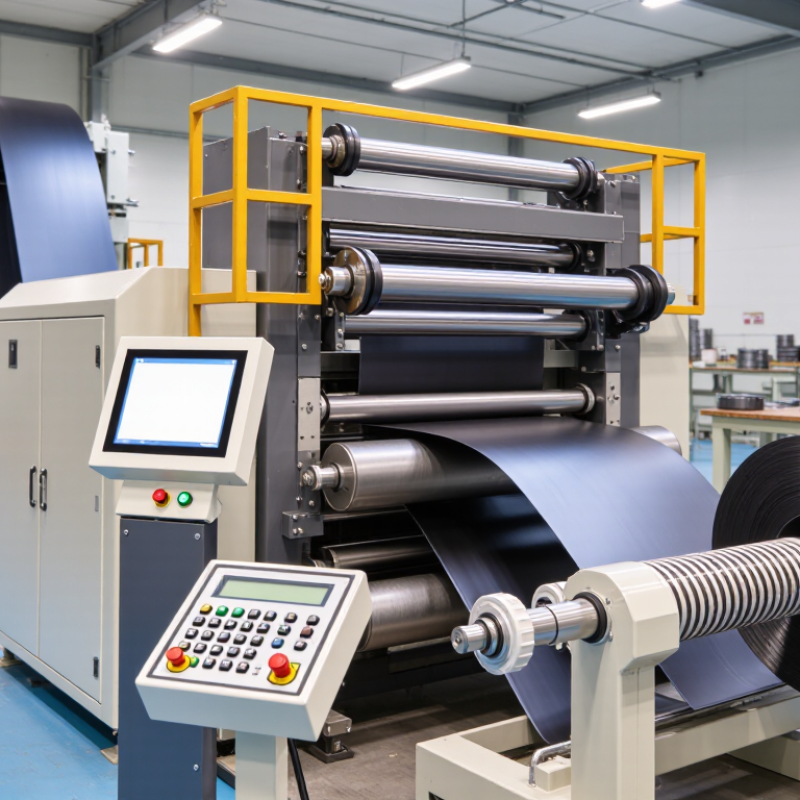
A rubber slitter cutting machine divides rubber material into narrower strips or sheets. It typically uses rotating knives and feed rollers to guide material through a controlled cutting path. The operator sets the blade spacing to match the required strip width. The machine may process rubber rolls, sheets, or flexible compounds, depending on its design.
That is the basic idea. In practice, rubber can stretch, grip the rollers, or deform under pressure. Material thickness, hardness, and surface tack all affect the cut. A setup that works for firm rubber may not suit a soft, sticky compound. Small details matter.
A common assumption is that faster operation always improves output. It does not. Excessive speed can cause uneven edges or shifting material, especially when the feed is poorly adjusted. Operators should check blade sharpness, roller alignment, and cutting width before a production run. Guards and accessible stop controls also support safer operation. The exact settings need testing with the actual rubber; a sample cut often reveals issues that specifications alone miss.
China Best Rubber Slitter Cutting Machine Manufacturer?
How Does a Rubber Slitter Cutting Machine Work?
A rubber slitter turns a wide sheet or roll into narrower strips. Feed rollers guide the material and keep it moving at a controlled speed. Circular or shear knives cut along its length, while blade spacing determines strip width. Some machines use paired knives; others press rotary blades against an anvil. That sounds simple. In practice, rubber stretches, warms, and may cling to a blade. A clean edge is not guaranteed. Operators often test a short length, then adjust tension, blade clearance, and feed speed for the material’s thickness and compound.
The International Rubber Study Group’s 2024 World Rubber Industry Outlook projected global rubber demand above 31 million tonnes. That is market context, not a machine-performance claim, but it helps explain the value of consistent converting. During setup, check strip width at several points and inspect edges for tearing or distortion. Keep guards in place and use the machine’s safety interlocks. Honestly, a setting copied from another production line may fail: rubber formulations and temperature can change how the sheet behaves. Trial cuts take time, but skipping them can create uneven strips and wasted material.
Which Features Define a High-Quality Rubber Slitter?
A high-quality rubber slitter makes clean, repeatable cuts without pulling, tearing, or overheating the material. Look for a rigid frame, accurately aligned feed rollers, and adjustable blade clearance. These details matter when rubber sheets vary in thickness or hardness. A sharp blade helps, but it cannot compensate for poor alignment. Small setup errors can leave ragged edges or uneven strips.
The machine should also offer stable speed control and straightforward blade adjustment. Operators need accessible emergency stops and guards around moving parts; ISO 12100 provides a framework for assessing machinery risks. The U.S. Tire Manufacturers Association’s 2019 Scrap Tire Management Report estimated that 76% of U.S. scrap tires went to beneficial end uses. That figure does not measure slitter performance, but it highlights the value of reducing avoidable material waste. Better cutting control can help.
Check the details, not just the brochure. Ask for sample cuts using your own rubber, and inspect edge quality, width consistency, and heat marks. Confirm that replacement blades are available and maintenance tasks are clear. A perfect cut is not the whole story. Noise, dust, and operator access deserve attention too; these are easy to overlook during a fast demonstration.
| Feature | What to Look For | How to Verify It |
|---|---|---|
| Cutting accuracy | Consistent strip width and clean, straight edges across the intended material and operating speed. | Run a sample using the actual rubber grade and thickness; measure several strips across the roll and compare results with the agreed tolerance. |
| Blade system | Blade type, material, geometry, and sharpening or replacement method suited to the rubber compound and cut requirements. | Confirm blade options and service instructions, then inspect sample cuts for tearing, burrs, compression, or excessive heat marks. |
| Slitting-width adjustment | A clear, repeatable way to set knife spacing, with secure blade holders that remain stable during operation. | Set multiple widths, record the settings, and check whether the machine returns to those widths after adjustment. |
| Material feeding and tension | Controlled feeding that keeps the sheet or roll aligned without unwanted stretching, slipping, or wrinkling. | Test the machine with the intended material dimensions and surface characteristics; check tracking and cut consistency from start to finish. |
| Range of material capability | Clearly stated limits for material width, thickness, roll diameter, and rubber types. Performance can vary with hardness, reinforcement, and compound. | Compare the machine’s documented operating range with the actual production specification and test representative materials before purchase. |
| Speed and production stability | A stated working speed that is achievable with acceptable cut quality and stable material handling—not just a maximum-speed figure. | Request a sustained production run using the intended material; review output quality, stoppages, and speed under normal operating conditions. |
| Machine frame and alignment | A rigid frame, accurately aligned rollers and blade assemblies, and components appropriate for the expected workload. | Inspect build quality and alignment; check for unusual vibration, movement, or changes in cut quality during operation. |
| Controls and setup | Clearly labelled controls and practical procedures for setup, speed adjustment, shutdown, and changeover. | Ask operators to complete a setup and routine changeover using the manuals and controls supplied with the machine. |
| Safety provisions | Appropriate guarding, emergency-stop access, safe access for adjustment, and documented risk-control measures for the machine configuration. | Review the safety documentation and inspect safeguards against the requirements applicable at the installation site. Do not assume compliance without evidence. |
| Maintenance and spare parts | Accessible wear parts, clear maintenance intervals, and documented availability of blades and other replacement components. | Review the parts list, maintenance schedule, replacement procedures, and expected lead times for commonly serviced items. |
| Electrical and operating documentation | Documentation covering the supplied electrical configuration, operating instructions, troubleshooting, and installation requirements. | Confirm that manuals and electrical information match the delivered machine and the voltage and frequency available at the installation site. |
| Application-specific acceptance test | Performance criteria defined around the buyer’s material, finished strip dimensions, production needs, and acceptable edge quality. | Agree on sample materials, measurement methods, and acceptance criteria before ordering; retain test results for delivery inspection. |
Note: The most suitable rubber slitter depends on the rubber compound, material dimensions, required strip widths, and production process. Verify specifications with application-specific testing.
A reliable evaluation starts with your own rubber, not a catalogue. Ask the manufacturer to slit samples matching your compound, thickness, and width. Check edge quality under good lighting, then measure several strips for width variation. Record line speed and changeover time, too.
Real material matters. Request a written test report and confirm which blade type, feed system, and adjustment method produced those results. A polished demonstration may hide the difficult part: repeatability across different batches.
Review safety and service alongside cutting performance. ISO 12100 provides a framework for machinery risk assessment, while ISO 13849-1 addresses safety-related control systems; ask for relevant documentation rather than assuming compliance.
The International Federation of Robotics reported 541,302 industrial robot installations worldwide in 2023, with Asia accounting for about 70%. This broader factory-automation figure is not slitter-specific, but it highlights why control integration and operator training deserve attention.
That distinction matters. Check whether technicians can explain setup procedures clearly, and ask how quickly common wear parts can be supplied.
No checklist is perfect; I would still want to see the machine run with my material before judging its advertised precision.
Rubber slitter cutting machines are used wherever wide rubber rolls must become precise strips. Tire manufacturers slit calendered sheets for inner liners and other tire components. Automotive suppliers cut rubber for seals, gaskets, hoses, and vibration pads. Conveyor-belt makers, roofing producers, and footwear factories also rely on consistent widths. A clean edge matters.
The USGS Mineral Commodity Summaries 2024 estimates global natural-rubber production at about 15 million metric tons in 2023. This figure shows the scale of the raw-material supply, not the volume processed by slitters. In practice, machine requirements vary: tire plants often prioritize speed and repeatability, while conveyor workshops may need to handle thicker, reinforced sheets. Uneven rolls can cause waste. That detail is easy to miss.
Tips: Match blade type and machine capacity to rubber thickness and reinforcement. Test a short strip first, then check its width and edge before running a full roll. A quick setup check can prevent a long batch of rework.