
585.204.6770
sale@sanblueplastics.com
Your Source for Trays!
Choosing the best Sock Making Machine from China requires more than comparing online prices. A machine may look affordable, yet its real cost includes installation, needles, software, spare parts, electricity, and operator training. In a busy workshop, one repeated needle failure can stop production for hours. That delay may cost more than the original price difference.
Industry data shows why this decision deserves careful research. Textile Exchange’s Materials Market Report 2024 states that global fiber production reached approximately 124 million tonnes in 2023. It could rise to about 160 million tonnes by 2030. This expansion supports continuing investment in knitting and hosiery equipment. Grand View Research also identifies steady growth in the global hosiery market, driven by sportswear, medical socks, and everyday clothing. However, broad market growth does not guarantee that every Chinese machine offers equal value.
ITMF’s textile machinery reports confirm strong global investment in modern production equipment, but they do not provide a universal price list for sock machines. That limitation matters. Prices vary with cylinder diameter, needle count, computer control, output speed, brand reputation, and after-sales service. A basic model may suit standard cotton socks, while compression or seamless designs require more precise technology. Some quotations appear complete but exclude molds, freight, commissioning, or taxes. This guide compares those details carefully. The cheapest option may not be the best option. In practice, reliable service, stable stitching, accessible spare parts, and verified production samples often matter more than a low opening price. Mistakes still happen. Good buyers leave room for testing and reconsideration.
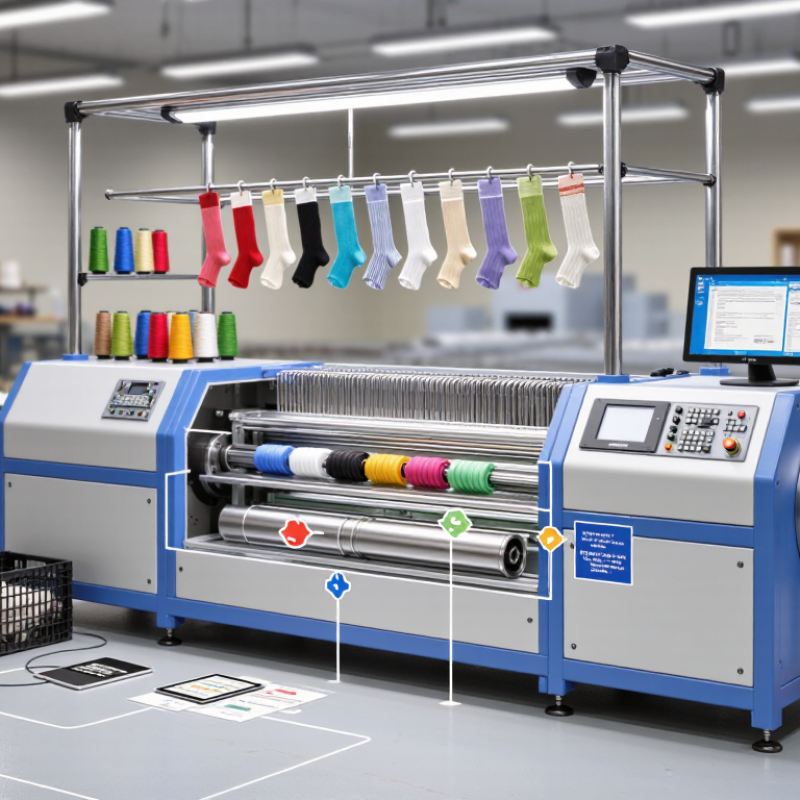
A sock making machine is a knitting machine that turns yarn into a shaped tube of fabric. In many models, yarn passes through tensioners and guides before feeding into needles arranged around a cylinder. As the cylinder turns, the needles form loops, creating the sock’s cuff, leg, heel, and foot. Controls adjust stitch patterns and machine speed. Some machines knit the toe closed; others require a separate linking step.
The details matter. Needle count, cylinder size, and control settings affect fabric density, sock size, and production flexibility. A buyer should ask to see a sample made with the intended yarn, not just a machine demonstration. Grand View Research estimated the global hosiery market at USD 56.65 billion in 2023, indicating a sizeable market for knitted socks and related products. That figure describes the market, not machine sales. A machine’s quoted price also depends on automation, output, and included equipment. One awkward reality: higher speed alone does not guarantee lower costs. Poorly matched yarn or settings can lead to dropped stitches and wasted material. Test the actual product.
China’s sock-making machines are mainly circular hosiery machines, offered in several configurations. Single-cylinder models are common for everyday socks, athletic styles, and terry cushioning. Double-cylinder models can knit rib structures and shaped patterns, but setup and operator skill matter. Computerized jacquard is a patterning option, not a separate cylinder type. Small distinction, big effect.
ITMF’s 2023 International Textile Machinery Shipment Statistics recorded about 27,000 large circular knitting machines shipped worldwide in 2022, down roughly 9% from 2021. This category is broader than sock machines, so it indicates equipment activity, not hosiery demand. When comparing Chinese quotations, check cylinder diameter, needle count, gauge, feed count, and whether toe-closing equipment is included. Ask for a sample knitted in your actual yarn; a showroom swatch can hide tension problems. Terry, jacquard, and double-cylinder options may raise the price, but the right choice depends on product mix and daily output. I would not choose by speed alone. A fast machine can still waste yarn if changeovers are frequent.
| Machine Type | Typical Use | Indicative Price Range (USD) | Key Selection Factors | Best Suited For |
|---|---|---|---|---|
| Computerized single-cylinder sock knitting machine | Knits common casual, dress, sports, and basic patterned socks. Different cylinder diameters and needle counts support different sizes and gauges. | US$5,000–12,000 | Needle count, cylinder diameter, knitting speed, pattern capacity, yarn compatibility, and included controls. | Factories producing a broad range of standard socks. |
| Terry sock knitting machine | Produces socks with looped terry fabric, often used for cushioning in sports, work, and winter socks. | US$7,000–15,000 | Terry depth and coverage, yarn-feed configuration, available sizes, and whether the machine can also knit plain sections. | Manufacturers focused on cushioned or performance socks. |
| Jacquard sock knitting machine | Creates knitted patterns and color designs; available configurations differ in the number of colors and pattern capabilities. | US$9,000–20,000 | Color capacity, pattern complexity, software, design-change workflow, and production speed with multi-color patterns. | Producers making customized or visually detailed socks. |
| Double-cylinder sock knitting machine | Uses two needle cylinders to make ribbed structures and certain shaped or patterned sock constructions. | US$8,000–18,000 | Supported structures, needle configuration, size range, operator experience, and compatibility with the required yarns. | Factories whose product specifications require double-cylinder construction. |
| Toe-closing machine | Closes the toe opening after knitting. Depending on the model, closure may use linking or another sewing method. | US$1,000–4,000 | Closure method, seam comfort, output speed, sock-size range, and compatibility with the knitting workflow. | Production lines seeking a consistent, dedicated toe-finishing step. |
| Automatic sock boarding machine | Shapes and heat-sets socks on forms after knitting and finishing. | US$2,000–8,000 | Number and size of forms, heating method, cycle time, temperature control, and energy requirements. | Producers needing more consistent sock shape and presentation. |
| Yarn winding machine | Rewinds yarn onto packages suitable for feeding into knitting machines. | US$500–3,000 | Number of winding positions, package dimensions, tension control, and supported yarn types. | Factories that prepare yarn in-house or need additional winding capacity. |
| Price and buying note: The figures are indicative equipment-only ranges, not quotations. Actual prices vary with machine specifications, automation, accessories, order quantity, and supplier terms. Confirm the required sock samples, needle configuration, installation and training, spare parts, warranty, shipping, duties, and taxes before comparing offers. | ||||
A sock making machine’s price depends on what it must produce, not just its advertised speed. Cylinder diameter, needle count, and gauge affect the fabric range and machine cost. A fine-gauge setup for lightweight dress socks may differ greatly from one designed for thick sports socks. Single- and double-cylinder models also suit different knitting needs. More yarn feeders and pattern controls can expand design options, but they add cost and require skilled setup. Small details matter.
Automation is another major factor. Electronic pattern control, automatic color changes, and fault detection may reduce manual work, yet their value depends on production volume and operator experience. Ask suppliers for a clear list of included parts, training, warranty coverage, and spare-part prices. A low quote may exclude installation or essential accessories. That can change the real cost. Consider output at your intended settings, not only the highest advertised rate; frequent changeovers can slow production. Frame stability, component quality, and service response also affect long-term costs. Compare total ownership costs over several years, including energy, maintenance, and downtime. There is no perfect quote. Even careful estimates can miss a production problem, so test the machine with your yarn and sample designs before committing.
Comparing Chinese sock machine manufacturers takes more than checking the quoted price. Ask each supplier for the same details: cylinder diameter, needle count, production speed, compatible yarns, and supported sock types. A machine listed as “high speed” may perform differently with thick yarn or complex patterns. Request a sample made to your specification, then inspect stitch consistency, toe closure, and sizing after washing.
Look closely at the model configuration. Two machines can share a similar name but include different controls, feeders, or pattern functions. Ask for a written specification sheet and confirm which parts are included in the price. A short video of the machine running is useful, but it cannot replace a live demonstration or a trial using your own yarn. Small details matter.
Compare service as carefully as hardware. Check response times, spare-parts availability, installation support, and operator training. Ask what maintenance is needed after a set number of operating hours. The lowest quote may exclude useful support, while a higher quote may include it; get both options itemized. Be cautious with broad output promises. Real production depends on design, yarn, operator skill, and downtime, so your own test results may differ from a brochure.
Choosing the best sock making machine starts with your product, not the advertised price. Define the sock types, sizes, yarns, and daily output your business needs. A machine for sports socks may not suit compression or delicate fashion socks. Check needle count, cylinder size, knitting speed, and pattern capacity. These details affect quality more than a low purchase price.
Tips: Request sample socks made with your yarn. Inspect the toe, elastic band, stitching, and fabric tension. Ask for a live demonstration, maintenance schedule, spare-parts list, and operator training. Confirm power requirements and installation support before payment. The cheapest machine can become expensive when production stops.
Reliable selection also requires practical testing. Compare total ownership costs, including electricity, labor, replacement parts, software, and technical service. Review written specifications carefully, because marketing figures may show maximum speed rather than stable output. Ask how the machine performs during an eight-hour production shift. Small defects may appear only after continuous operation. I would not trust a decision based on price alone. In one trial, slower settings produced cleaner patterns and fewer rejected socks. That trade-off was easy to overlook. Choose equipment that matches your current orders while allowing moderate growth. A clear warranty, responsive support team, and verified user feedback can reduce operational risk.