China Top 10 Mother Tissue Roll Manufacturers for Buyers
Choosing among China’s top 10 Mother Tissue Roll manufacturers takes more than comparing price lists. Buyers need to assess the parent jumbo roll’s basis weight, ply structure, fiber blend, moisture, and reel dimensions. These details affect converting speed, tissue feel, and waste. A sample that looks smooth under bright showroom lights may behave differently on a fast production line. Test it on your own equipment.
Tissue-industry analyst Brian McClay is often associated with a market-focused view of the sector. A useful buyer’s principle, expressed here as an editorial takeaway rather than a verified direct quotation, is: “Consistent quality and dependable supply matter as much as the quoted price.” This distinction deserves attention. Supplier evaluations should include technical data, production capacity, packaging, lead times, and the process for handling quality concerns. Request recent specifications and, where practical, trial rolls before committing to large volumes.
This guide compares ten manufacturers through buyer-relevant factors, including product range, export experience, customization, and communication. It does not assume that one supplier suits every converter. A small operation may value flexible order quantities, while a high-speed mill needs stable reel performance and reliable delivery schedules. Verify claims directly with each manufacturer. Ask clear questions. Keep records. Even a careful shortlist can miss something; that is worth remembering.
Mother Tissue Rolls Explained: Typical 13–40 GSM Grades and Reel Specs
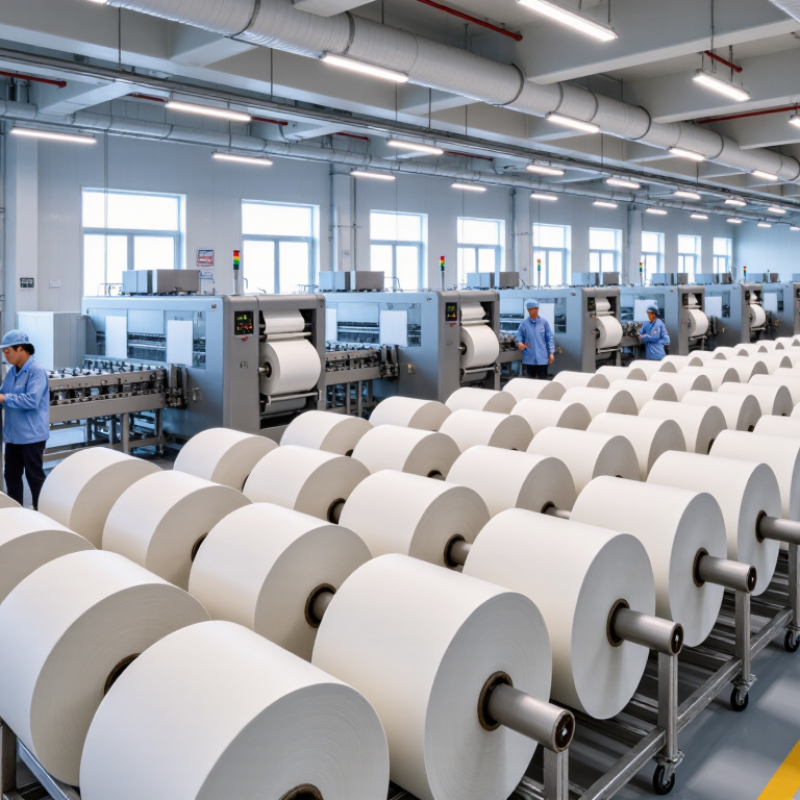
Mother tissue rolls are parent reels used by converters to make products such as toilet tissue, facial tissue, and napkins. GSM means grams per square metre, so it describes sheet weight, not softness by itself. Around 13–18 GSM, tissue is generally light and suited to delicate, absorbent products. Grades near 19–25 GSM can offer a balance of strength and flexibility. Heavier grades, roughly 26–40 GSM, may suit thicker or more durable products, depending on the furnish and ply design. These ranges are guides, not fixed rules. Small differences matter.
Reel specifications deserve equal attention. Buyers typically confirm web width, roll diameter, core diameter, and net weight, then check whether the reel fits the unwinder and converting line. A roll that is too wide can cause trimming waste; an oversized diameter may not fit the loading area. Ask for tolerances, winding direction, splice limits, and moisture details where relevant. I would not treat GSM as a complete quality score. A tidy specification sheet can miss how a reel behaves at production speed. Request a representative sample and, if possible, test it on the intended machine before agreeing to repeat orders.
China Top 10 Mother Tissue Roll Manufacturers for Buyers - Mother Tissue Rolls Explained: Typical 13–40 GSM Grades and Reel Specs
Buyer reference: common product specifications and evaluation points. Values are indicative; actual specifications vary by mill, grade, machine, and order.
| No. | Buyer Checkpoint | Typical Specification or Range | What Buyers Should Confirm |
| 1 | Lightweight tissue grades | About 13–16 GSM per ply | Suitable end uses may include lightweight toilet tissue and facial tissue; check softness, strength, and converting performance. |
| 2 | Standard tissue grades | About 17–22 GSM per ply | Often considered for toilet tissue, napkins, and general-purpose tissue products; specify the intended product and ply construction. |
| 3 | Heavier tissue grades | About 23–40 GSM per ply | May be used for towel, napkin, or other higher-basis-weight products; verify absorbency and wet-strength requirements where applicable. |
| 4 | Ply and finished basis weight | Single-ply or multi-ply; state GSM per ply and total finished basis weight separately | Avoid comparing a per-ply GSM figure with a finished multi-ply product figure. |
| 5 | Furnish and pulp composition | May include virgin pulp, recycled fiber, or a specified blend | Request the declared furnish, applicable recycled-content documentation, and any required product or market compliance records. |
| 6 | Parent-roll width | Common machine widths are mill- and machine-dependent; confirm the exact usable width for the converting line | Specify roll width in millimetres, allowable tolerance, and whether edge trim or damaged edges are included. |
| 7 | Parent-roll diameter | Set to match the unwinder and handling equipment; maximum diameter varies by line | Confirm maximum and minimum diameter, roll weight, and the measurement method before placing an order. |
| 8 | Core inside diameter | Common options include approximately 76 mm and 152 mm, subject to equipment compatibility | Confirm core material, inside diameter, wall thickness, and required core strength. |
| 9 | Roll quality and winding | Check winding firmness, roll edge condition, splice policy, and web uniformity | Agree on defect limits, roll identification, inspection records, and handling of non-conforming rolls. |
| 10 | Sampling, testing, and shipment | Use an agreed specification, representative sample, and documented test method | Confirm GSM tolerance, moisture, tensile or absorbency tests as relevant, packaging, palletization, lead time, and shipping terms. |
Quality Benchmarks: ISO 12625 Tests for Grammage, Tensile, and Absorption
China Top 10 Mother Tissue Roll Manufacturers for Buyers: Quality Benchmarks Under ISO 12625
A supplier’s “soft and strong” claim needs measurable evidence. ISO 12625-6 specifies grammage testing, reported in grams per square metre (g/m²). ISO 12625-4 covers tensile strength and stretch, while ISO 12625-8 measures water-absorption time and capacity using a basket-immersion test. These methods help buyers compare samples on consistent terms. They do not establish one universal pass value for every tissue grade.
Ask for dated laboratory reports that identify the test method, sample conditioning, and roll or lot number. Compare grammage variation across samples, not just a single average. Check tensile results in both machine and cross directions; a sheet can resist pulling one way and tear easily across the other. For absorption, record both the time taken and the amount retained. A fast result is useful, but it may come with lower strength. Real trade-offs matter.
Tips: Request replicate results and keep a sealed reference sample. Test the tissue as converted, too: embossing and winding can change how it behaves. A tidy spreadsheet is not proof of consistent production. Sometimes the numbers look fine, and the roll still feels wrong in use. That deserves a closer check.
China Top 10 Mother Tissue Roll Manufacturers for Buyers
Quality Benchmarks: ISO 12625 Tests for Grammage, Tensile, and Absorption
The chart shows illustrative grammage readings for anonymized tissue samples, not measured supplier data or ISO acceptance limits. ISO 12625-3 covers grammage, ISO 12625-4 covers tensile properties, and ISO 12625-8 covers water-absorption time and capacity. Compare tensile and absorption results separately using their appropriate units and test conditions; the standards do not define one universal pass value for every tissue grade.
China’s Top 10 Manufacturers: Capacity, Certifications, and Export Markets
China’s top ten mother tissue roll manufacturers should be compared by verified annual output, machine width, and product consistency—not by installed capacity alone. The China Paper Association’s 2023 industry report puts household paper production at about 11.6 million tonnes. That figure describes the wider sector, not the output of any single mill. A buyer should ask for recent production records, reel-weight tolerances, and sample rolls from the actual production line. Capacity matters. But uptime matters too.
Certifications help assess process controls, yet their scope needs checking. ISO 9001 covers quality management, while ISO 14001 addresses environmental management; neither guarantees a particular tissue grade. For forest-based claims, verify the certificate’s validity and product scope through the issuing scheme’s public registry. Ask for test data on basis weight, moisture, tensile strength, and brightness. Small variations can affect converting speed and finished-roll quality.
Export-market claims also need careful reading. UN Comtrade reports trade under HS 4803, a category that may include tissue stock and related paper products. It is not a precise measure of mother-roll exports. Manufacturers serving Southeast Asian, Middle Eastern, or African buyers should provide destination-specific shipping records and explain how they protect jumbo rolls from moisture during transit. A neat certificate file is useful; it is not a substitute for a trial order.
Compare Suppliers by GSM, Reel Width, MOQ, Lead Time, and Price per Ton
When comparing China’s mother tissue roll manufacturers, request quotations against one shared specification. Record GSM, reel width, parent-roll diameter, core size, and paper grade. A small GSM difference can affect softness, converting performance, and yield. Small details matter.
Confirm whether width is stated in millimeters and whether the quoted weight is net paper weight. Ask suppliers to state their minimum order quantity in tons, rolls, or containers; these units are not interchangeable.
For a trial, check whether a smaller run is possible and whether it carries a higher per-ton charge.
Compare lead time from a clear starting point, such as deposit confirmation or artwork approval, and separate production time from shipping time. Ask whether the stock is ready or made to order.
For price per ton, confirm currency, packaging, payment terms, and which transport costs are included. Not always. A low quote may reflect a different GSM, moisture level, or freight basis, so compare like with like.
Request a sample roll or recent quality data, then check basis weight and runnability with your own converting settings.
A spreadsheet can still mislead if specifications are incomplete; even careful buyers may need to revise their comparison after testing.
Buyer Verification: Mill Audits, Sample Testing, and China Paper Association Data
For buyers comparing China’s top mother tissue roll manufacturers, an audit should verify the mill behind the quotation, not just the trading office. Ask to see the pulping, tissue-machine, rewinding, and packing areas. Check whether the equipment is running and whether batch records match the production date. Small details matter. Request recent quality logs, wastewater procedures, and a clear explanation of how defects are handled.
Sample testing should use agreed specifications. Measure roll width, diameter, core size, basis weight, and sheet count; then check softness, absorbency, and tensile strength. Record the test method and sample lot, since results can shift with moisture and storage. One attractive sample proves little. Ask for samples from more than one production lot, and keep sealed reference pieces for comparison. A repeat test may be inconvenient, but it can expose variation before a large order.
China Paper Association data can provide useful industry context, such as sector trends, but it cannot certify a particular mill’s output. Cross-check any figures against current association publications and the supplier’s own dated records. Treat membership claims as leads, not proof of capacity or quality. Even a careful audit has limits: it may capture one clean shift, not every shift. Note that gap in the buyer’s assessment.