585.204.6770
sale@sanblueplastics.com
Your Source for Trays!
Choosing plastic totes for global sourcing requires more than comparing unit prices. A tote may look sturdy in a supplier’s photograph, yet feel flexible when loaded with metal parts. The right decision begins with the application. Review product weight, dimensions, stacking height, handling equipment, storage temperature, and cleaning requirements. Confirm whether the tote must nest, collapse, or remain rigid during transport. Small details matter. A lid that shifts can expose goods to dust. A weak corner can damage during repeated handling.
Experienced buyers usually request samples before approving production. Test them under realistic conditions, including full loads, stacking, vibration, and manual lifting. Record deformation, odor, surface damage, and label adhesion. Ask suppliers about resin type, recycled content, wall thickness, mold quality, and batch consistency. Independent inspection can verify dimensions and visual standards before shipment. It also helps compare factories fairly across regions. Documentation should include drawings, tolerances, packaging details, and agreed acceptance criteria. Requirements may differ between countries, so confirm applicable product, packaging, and transport standards with qualified local professionals.
Cost still matters, but landed cost tells a clearer story. Freight volume, storage space, damage rates, duties, and return handling can change the result. A cheaper tote may become expensive after one rough shipment. No checklist is perfect. I once underestimated cleaning time because the ribbed base trapped small debris. That mistake changed the specification. Strong sourcing decisions combine supplier evidence, practical testing, and honest review. The best plastic totes are not simply affordable; they remain reliable from factory floor to final destination.
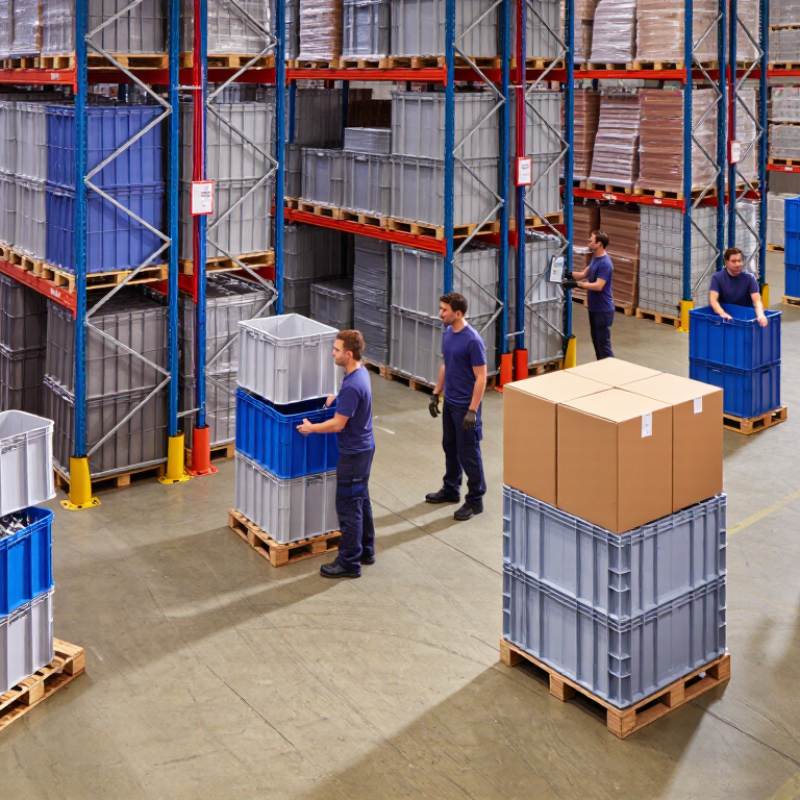
Choosing plastic totes for global sourcing starts with matching physical demand to HDPE behavior. Standard HDPE typically falls near 0.94–0.97 g/cm³, according to ASTM D4976 classifications. That density supports strong walls without making empty totes excessively heavy. However, density alone does not determine performance. A 600 × 400 × 300 mm tote holds about 72 liters, yet usable volume decreases with ribs, handles, and nesting design. Measure the product, not the catalogue headline.
Map the load in three directions: weight, volume, and handling frequency. For a 20-kilogram load, compare the rated capacity with repeated stacking, vibration, and temperature changes. ISO 6780 identifies 1,200 × 800 mm and 1,200 × 1,000 mm pallet footprints as common international formats. Tote dimensions should divide efficiently into those footprints, reducing empty space during ocean or road transport. PlasticsEurope reported global plastics production at 400.3 million tonnes in 2022, with packaging representing about 39 percent. That scale makes material efficiency worth measuring carefully.
Turnover changes the decision. High-turnover operations may justify reinforced rims, washable surfaces, and durable hinges. Low-turnover lanes may favor lighter, nestable designs. Track trips per year, loss rates, and return distance. Our first spreadsheet underestimated return freight. It looked efficient. It was not. Also test a loaded tote after cold storage and rough handling. A perfect laboratory result can still fail on a wet warehouse floor.
Material choice shapes tote performance, cost, and shipping efficiency. Polypropylene, or PP, typically has a density of 0.90–0.91 g/cm³. That lower weight can reduce freight costs without making the container feel fragile. PP also tolerates repeated handling and moderate heat well. It suits warehouse totes exposed to warm equipment, sunlight, or frequent washing.
HDPE HDPE is denser, usually around 0.94–0.97 g/cm³. It often performs better under sudden impact, cold storage, and rough loading conditions. A dropped HDPE tote may resist cracking when temperatures fall. PP can become less forgiving in cold environments. The correct choice depends on actual use, not material labels alone. Wall thickness matters greatly.
In sourcing trials, I compare both materials using filled totes, stacked loads, and repeated lid cycles. The first sample is rarely perfect. A lightweight PP tote may save freight, yet its rim could flex during automated handling. A thicker HDPE tote may survive abuse, but increase shipping volume and unit cost. Ask suppliers for density data, temperature ranges, impact results, and sample testing. Check dimensions after nesting, too. Small design differences can change pallet counts across borders. Always review destination-market requirements for intended contents and recycling marks. Supplier documents help, but practical testing reveals weaknesses that specifications sometimes hide.
Tote selection should begin with measured dimensions, not catalog labels. Record internal length, width, height, usable volume, and nesting loss. A 600-millimeter tote may hold less after dividers and protective spacing. Filled weight matters more than empty weight. The U.S. Department of Transportation’s Freight Facts and Figures 2023 reported that trucks moved about 12.9 billion tons in the United States during 2022. That volume creates repeated vibration, impacts, and handling pressure. Your tote must survive the journey, not just warehouse storage.
Validate stacking under realistic conditions. Measure the load transferred through the rim, corner posts, and base. Include temperature, humidity, pallet quality, and storage duration. ASTM D4169-22 requires a defined distribution cycle, assurance level, conditioning process, and acceptance criteria. Do not simply request an “ASTM-tested” tote. The test schedule must reflect your transport route and package weight. A tote passing one cycle may fail another.
I have seen projects use nominal stack ratings without testing filled totes. That is risky. Calculate the lower stack load, then apply a documented safety margin. Test loaded samples after conditioning, not only new samples at room temperature. Small details matter. Lid fit, label damage, and deformation can also disrupt automated handling. My own preference is to pilot one shipment, inspect corner collapse and scuffing, then revise the specification. The first design is rarely perfect.
An ISO 9001 certificate is a useful starting filter, not a quality guarantee. The ISO Survey 2022 recorded 1,265,216 ISO 9001 certificates across 187 countries. Ask suppliers for the certificate number, scope, expiry date, and latest audit findings. The scope should cover plastic tote production, not only office management. Request records for resin control, mold maintenance, dimensional checks, and corrective actions. A certificate is useful, but it is not proof of disciplined production.
Use AQL 1.5 with a defined sampling plan. ANSI/ASQ Z1.4 connects lot size, inspection level, sample quantity, and acceptance numbers. Do not write “AQL 1.5” alone on a purchase order. Define critical, major, and minor defects separately. Check wall thickness, lid fit, stacking strength, color consistency, and deformation after loading. The 2023 World Bank Logistics Performance Index gathered responses from 4,090 supply-chain professionals in 60 countries. Its findings reinforce one point: supplier communication and delivery reliability need measurable controls.
Tips: Approve a production sample before mass manufacturing. Compare ten randomly selected totes against the signed sample. Photograph measurements beside a calibrated gauge. Record resin grade, weight, dimensions, and load-test results. I still find this step uncomfortable. Samples can look excellent while production quietly changes. Re-audit after tooling repairs, material substitutions, or major order increases. Require timestamped inspection records, but verify them independently.
Choosing plastic totes for global sourcing requires more than comparing factory prices. Under Incoterms 2020, the seller’s quoted price may exclude freight, insurance, import clearance, duties, and inland delivery. ICC explains that each rule assigns different cost and risk points. A lower FOB quote can therefore become expensive after arrival. UNCTAD’s Review of Maritime Transport reports that ships carry over 80% of global merchandise trade by volume, yet freight costs remain sensitive to route, season, and congestion.
For totes classified under HS 3923.10, verify the description with the destination customs authority. The World Customs Organization’s Harmonized System supports classification, but each country applies its own tariff and tax treatment. HS 3923.10 is not a universal duty rate. Ask suppliers for carton dimensions, gross weight, pallet count, and loading photos. Then compare landed cost per usable tote, not per factory unit. A 10,000-piece MOQ may reduce unit price, but it can increase storage, financing, and damage exposure. I have seen “cheap” inventory become costly when warehouse space was ignored.
Tips: Build three scenarios: FOB, CIF, and DDP. Add duty, brokerage, port fees, delivery, inspection, and insurance. Test 1,000, 5,000, and 10,000 pieces. Recheck assumptions. Supplier lead time also matters. A spreadsheet should show cash tied up for each MOQ, including slow-moving stock. Small errors can survive until the shipment arrives.
Estimated landed cost per tote under Incoterms® 2020, HS 3923.10, and different MOQ levels
Planning model for plastic boxes, cases, crates and similar articles classified under HS 3923.10. Costs are shown in USD per tote and include the product price, international freight, destination handling, customs clearance, inland delivery, and an assumed 5% import duty. VAT, local taxes, demurrage, and tooling are excluded. Actual duty and classification should be confirmed with the importing customs authority.