
Your Source for Trays!

How to Choose Biodegradable Cosmetic Packaging?

Choosing Biodegradable Cosmetic Packaging is not as simple as swapping plastic for a plant-based material. A cream jar, shampoo bottle, and serum pouch face different demands. Each must protect its formula, survive shipping, and work with the intended disposal route. Small details matter: a pump may contain mixed materials, while a coated paper tube may resist breakdown. Appearance alone tells you little.

William McDonough, a leading voice in circular design, is associated with the principle, “Waste equals food.” It offers a useful lens for packaging choices, though it is not a cosmetics-specific instruction. The practical question is whether a package can return safely to a suitable system after use. Look closely at material composition, product compatibility, credible test information, and available composting or collection facilities. Check the closure, label, liner, and decoration too. They can change the outcome. “Read the fine print.” A biodegradable claim does not guarantee that packaging will break down in a home compost bin, or in local conditions. I have seen how easily a promising sample can become a poor fit when a cap or coating is overlooked. That is worth admitting. This guide explores how to compare materials, verify claims, and balance shelf life with end-of-life options, without treating one material as a universal answer. The right choice depends on the product, the customer, and the disposal pathway.
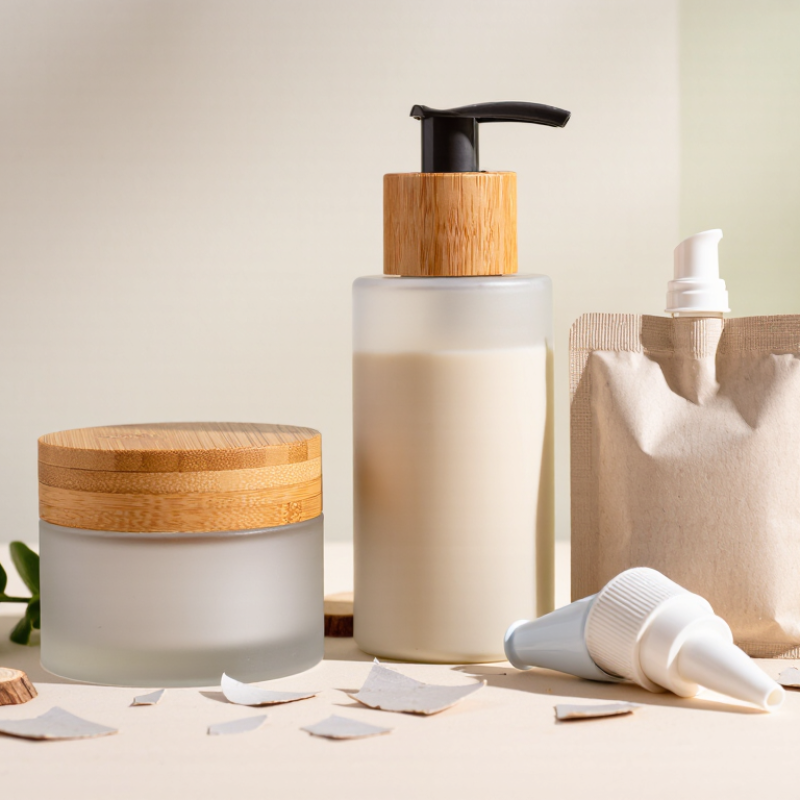
How to Choose Biodegradable Cosmetic Packaging?

Define Biodegradable, Compostable, and Home-Compostable Packaging Claims

Biodegradable means microorganisms can break a material down, but the word alone does not say how quickly or under what conditions. A tube might degrade in industrial composting but remain intact in a cool backyard pile. Check whether the claim names a timeframe, disposal setting, and supporting test. Without those details, the claim is hard to judge.

Compostable is more specific: packaging is designed to break down in composting conditions and meet relevant criteria for the resulting compost. Some items need the steady heat and moisture of an industrial facility. Home-compostable packaging is tested for less controlled conditions, but results still depend on temperature, airflow, and what else is in the bin. A paper label, adhesive, or cap may also affect whether the whole package belongs there. This distinction is easy to miss.

Tips: Read the full disposal instructions, not just the front label. Check caps, pumps, liners, and labels separately. If a claim only says “biodegradable,” ask what conditions were tested. Do not assume a home compost pile can process every certified item; local conditions vary, and sometimes the package simply stays there longer than expected.

Apply EN 13432: 90% Biodegradation in 6 Months, Disintegration in 12 Weeks

How to Choose Biodegradable Cosmetic Packaging?
Apply EN 13432: 90% Biodegradation in 6 Months, Disintegration in 12 Weeks

EN 13432 gives buyers measurable criteria for compostable packaging. Under controlled industrial composting conditions, at least 90% biodegradation must occur within six months. Disintegration is assessed after 12 weeks: no more than 10% of the original dry mass may remain on a 2 mm sieve. These are laboratory test conditions, not a promise that packaging will break down in a garden compost bin or outdoors. That distinction matters.

When assessing a cosmetic container, look beyond the main bottle or jar. A compatible body may be paired with a conventional pump, label, adhesive, or cap that complicates composting. Ask for test documentation covering the finished packaging, and check whether its disposal instructions match local composting facilities. Certification can help, but it does not make every component suitable. Details count.

Tips: Request the EN 13432 test report and confirm which parts it covers. Check the disposal label before choosing a format. If a pump cannot meet the criteria, a simpler closure may be a better fit. It is not always the easiest redesign, but overlooking small parts can undermine the whole package.

How to Choose Biodegradable Cosmetic Packaging?

Key EN 13432 industrial-composting time limits: at least 90% biodegradation within six months, and disintegration within 12 weeks.

The bars show the maximum test periods, not measured progress. For disintegration, no more than 10% of the original dry mass may remain on a 2 mm sieve after 12 weeks. EN 13432 assesses packaging under controlled industrial composting conditions and includes additional requirements; it does not indicate home compostability.

Compare Disposal Routes with EMF’s 14% Plastic-Packaging Recycling Rate (2016)

When choosing biodegradable cosmetic packaging, compare its disposal route with the recycling figures behind the promise. In 2016, the Ellen MacArthur Foundation reported that only 14% of plastic packaging was collected for recycling globally. That is a historical global figure, not a current local rate. Still, it shows why “recyclable” on a jar does not guarantee it will be recycled. A biodegradable container may need industrial composting, where controlled heat and moisture help materials break down. If that facility does not accept it, the package could end up in landfill instead.

Check the exact material and disposal instructions. A paper carton may be recyclable, while its plastic window or coated lining complicates sorting. A compostable-looking tube may require commercial composting and should not go into a home compost bin unless its label says so. Pumps, caps, and labels may need to be removed. These details are easy to miss. The uncomfortable part is that there may be no perfect route: local recycling rules and composting access vary, and vague labels leave room for mistakes.

Tips: Check your local waste guide before buying. Look for clear disposal instructions, and separate removable parts when directed. If the route is unclear, pause and verify it; packaging claims can sound simpler than disposal really is.

How to Choose Biodegradable Cosmetic Packaging? — Compare Disposal Routes with EMF’s 14% Plastic-Packaging Recycling Rate (2016)

Disposal route Packaging most suited to the route What happens Conditions and limitations Practical choice for cosmetic packaging
Reuse Durable, refillable containers designed for repeated use The container is cleaned and refilled or reused instead of being discarded after one use. Requires a workable refill or return system, and packaging that can be safely cleaned and reused. Consider for sturdy jars, bottles, and dispensers when a convenient refill system is available.
Material recycling Packaging made from a locally accepted, identifiable material, such as a single-material plastic bottle or glass jar Collected material is sorted and processed into recycled feedstock or products. Acceptance varies by location. Pumps, mirrors, liners, labels, and mixed-material parts may need to be removed or may prevent recycling. Check local collection rules and make components easy to separate. Do not assume that “biodegradable” packaging belongs in a recycling bin.
Industrial composting Packaging certified as suitable for industrial composting under a recognized standard, where the local facility accepts it Controlled heat, moisture, and microbial activity support biodegradation and disintegration in a managed composting process. Industrial compostability does not mean home compostability. Facilities may not accept packaging, even when it is certified. Use only when the packaging is appropriately certified and a local industrial composting service confirms acceptance.
Home composting Packaging specifically certified or clearly verified as suitable for home composting Breakdown takes place in a home compost system, generally under less controlled conditions than industrial composting. Industrial-composting certification alone does not establish that a product will break down in a home compost heap. Conditions and times vary. Choose only when home-compost suitability is explicitly established; follow the packaging instructions and local guidance.
Landfill or residual waste Packaging that cannot be reused, recycled, or accepted by an appropriate composting service Waste is disposed of according to local residual-waste systems. Biodegradable materials may not break down as intended in landfill conditions. “Biodegradable” does not guarantee rapid or complete breakdown there. Do not select a biodegradable material on the assumption that landfill disposal will make it disappear safely or quickly.

Historical recycling context: The Ellen MacArthur Foundation’s 2016 report stated that globally, only 14% of plastic packaging was collected for recycling. This is a historical global figure, not a current local recycling rate, and collection does not mean that all collected packaging is ultimately recycled into new packaging.

References: Ellen MacArthur Foundation, The New Plastics Economy: Rethinking the Future of Plastics (2016); European standard EN 13432, requirements for packaging recoverable through composting and biodegradation; ASTM D6400, specification for plastics designed to be composted in municipal or industrial facilities. Always check current local collection and facility-acceptance rules.

Test Cosmetic Compatibility: Barrier Performance, Formula Stability, and Shelf Life

A biodegradable package can pass a material test and still fail with a real formula. European Bioplastics’ 2024 market data report estimated global bioplastics production capacity at 2.47 million tonnes, with packaging representing 45%. Those figures describe market capacity, not cosmetic protection. Test the actual formula in the actual pack.

Check oxygen and moisture barriers using suitable methods, such as ASTM D3985 and ASTM F1249 for plastic films. Then assess complete packs: closures, seams, pumps, and liners can create weak points. Watch for weight loss, leaks, swelling, or a pump that starts to stick. Small defects matter.

Follow ISO/TR 18811 guidance for cosmetic stability testing, comparing filled biodegradable packs with a control. Track color, odor, viscosity, pH, separation, and microbial quality under relevant storage conditions. Include real-time testing; accelerated aging alone may not predict every change. I would not trust a tidy lab result by itself. Test more than one production batch, and be candid when the evidence is limited. Shelf life should reflect observed results, not the material’s biodegradability claim.

Verify Every Component’s Claims and Certification Against EN 13432 or ASTM D6400

A “biodegradable” claim on a cosmetic jar is not enough. Check whether the exact packaging is covered by certification against EN 13432 or ASTM D6400. These standards assess compostability under specified industrial composting conditions. They do not establish that an item will break down in a garden, at home, or as litter. The distinction matters when customers lack access to industrial composting facilities.

Read the certificate’s scope carefully. Does it cover the jar, cap, pump, label, adhesive, ink, and any inner liner, or only the main container? A small pump or glossy label can change how the complete package performs. Request the certificate and supporting test documents, then compare product names, material types, colors, and thicknesses with the packaging you plan to buy. Check that the documentation is current, too. A supplier’s broad statement may not match the exact component or finished package.

Look for clear disposal instructions alongside the claim. “Compostable” can sound simpler than it is. If a component must be removed before processing, say so plainly. I would pause if a certificate is offered but its scope is vague; paperwork can look reassuring without answering the practical question. Verification takes time, and even careful checks cannot guarantee that a local composting facility accepts the package.

Article Source: