
585.204.6770
sale@sanblueplastics.com
Your Source for Trays!
Electric valves help control the movement of water, steam, oil, and process fluids with precise, remote operation. In factories, treatment plants, and building systems, the right valve can improve control and reduce routine manual work. But choosing a supplier takes more than comparing product photos or headline prices. Specifications matter.
This guide to the top 10 electric valve manufacturers in China introduces companies for buyers to research, rather than treating any list as a universal ranking. Manufacturers differ in valve types, actuator options, materials, production capacity, and after-sales support. A compact stainless-steel valve for a clean-water line has different needs from a large valve handling abrasive slurry. Those details change the shortlist.
We focus on practical checks: product range, technical documentation, quality controls, customization, export experience, and service responsiveness. Ask for datasheets, drawings, operating limits, and clear warranty terms. Where a project requires particular certifications or testing, verify current documents directly with the manufacturer. Do not assume every model shares the same approvals. Small details count.
A polished catalogue is useful, but it cannot prove performance in your operating conditions. We cannot verify every factory claim from a product page alone, and buyers should conduct their own checks. That part is less convenient. Still, careful comparison can help identify an Electric Valve supplier whose capabilities match the application, budget, and maintenance plan.
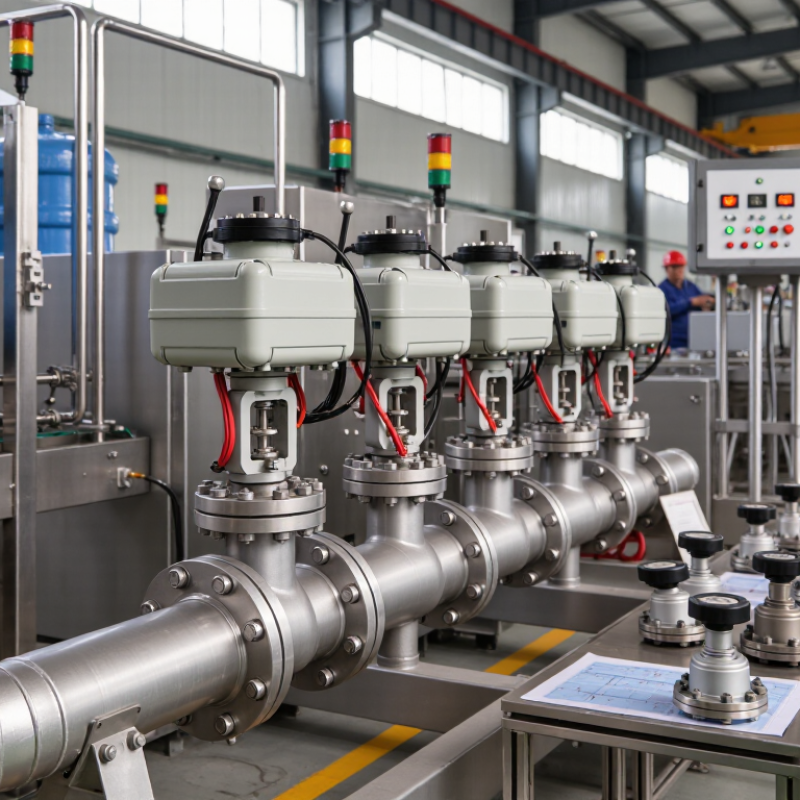
An electric valve uses a motor and gearbox to move a stem or rotate a ball or disc. The movement opens, throttles, or closes the flow path. A controller sends a command, while position feedback can confirm whether the valve reached its setpoint. Some units move in quarter-turns; others travel gradually. That difference matters when controlling a tank level or balancing a heating loop.
In water networks, treatment plants, building HVAC, and process lines, electric actuation supports repeatable remote control. UNESCO’s 2023 World Water Development Report estimates that agriculture accounts for about 72% of global freshwater withdrawals, making dependable flow control important in irrigation and water distribution. A valve’s performance still depends on correct sizing, pressure limits, and installation. A neat wiring diagram can hide a sticky stem. During commissioning, operators should check travel time, feedback, and behavior after power loss. Electric actuators may hold position or require a defined fail-safe arrangement; neither response should be assumed. Small details matter. A slow-closing valve, for example, can help reduce sudden pressure changes in a pipeline.
When assessing China’s electric valve manufacturers, look beyond catalogues and compare evidence from the same operating conditions. Ask for torque curves, cycle-test records, enclosure ratings, and material traceability. IEA’s Energy Efficiency 2023 report estimates that industry uses about 37% of global final energy. This is sector context, not a valve-performance benchmark. Still, it shows why reliable control and leakage prevention matter in industrial systems.
Check whether drawings and actuator interfaces match your application; ISO 5211 covers mounting dimensions, while relevant IEC 60534 standards address control-valve performance and testing. Request sample inspection records and clarify how faults, spare parts, and technical questions are handled. A polished catalogue can hide gaps in test documentation. No single metric settles it. Compare like with like: fluid, pressure, temperature, duty cycle, and control method.
Tips: Ask for a witnessed test on a representative unit, not just a general certificate. Check the serial number against the report. If a supplier cannot explain a test result in plain language, pause and investigate; my checklist may still miss site-specific risks.
China has a broad electric-valve manufacturing base, serving water, building services, and industrial plants. These ten profiles describe supplier strengths, not a verified ranking.
Capabilities vary. Buyers should compare pressure and temperature ratings, enclosure protection, material certificates, test procedures, and spare-part availability. A polished catalogue is not proof of long-term reliability; request relevant records and clarify operating conditions before selection.
Tips: Share the fluid, pressure range, temperature, voltage, and switching frequency when requesting a quotation. Ask for a sample test report. Check that the stated performance matches your installation, not just the product sheet.
Chinese electric-valve manufacturers typically supply motorized ball and butterfly valves, plus multi-turn gate and globe valves. Their catalogs often pair cast-iron, stainless-steel, or PVC bodies with quarter-turn or multi-turn actuators. Look for torque protection, position feedback, manual overrides, and communication options such as Modbus RTU. These details matter when a valve sits in a wet pump room or must respond to a control signal from a distant panel. Small specs, big consequences.
MarketsandMarkets estimated the global industrial-valve market at USD 78.4 billion in 2023 and projected USD 100.7 billion by 2028. That forecast signals demand, but it does not prove that any supplier’s product suits a particular plant. Buyers should check operating pressure, fluid compatibility, cycle frequency, enclosure rating, and actuator duty class. A useful comparison also asks whether diagnostic data is available and whether spare actuators can be sourced locally. Catalog claims can look tidy; installation conditions rarely are. One weakness in many comparisons is that they rank product breadth while overlooking commissioning support and replacement-part lead times. That omission can matter more than a long feature list.
Note: This is a non-ranked overview of common electric-valve product and technology categories available from manufacturers in China. Company names and brands are intentionally omitted; exact specifications and options vary by supplier and model.
| Profile | Common Electric Valve Products | Key Technologies and Options | Typical Applications |
|---|---|---|---|
| 01 | Electric ball valves, including two-way and three-way designs | Quarter-turn electric actuation; on/off or modulating control options; position feedback and manual override may be available | Water treatment, HVAC, industrial process lines, and general fluid isolation |
| 02 | Electric butterfly valves, including wafer and flanged configurations | Quarter-turn actuation; resilient-seated and metal-seated designs; actuator options for different operating torques | Water distribution, building services, cooling systems, and low-to-medium-pressure process service |
| 03 | Electric gate valves | Multi-turn actuators; open/close limit and torque switches; rising-stem and non-rising-stem configurations | Water networks, utility systems, and pipelines where a full-bore isolation valve is required |
| 04 | Electric globe valves and motorized stop valves | Linear actuation; shutoff and throttling configurations; position control can be specified for compatible systems | Steam, hot water, and process lines requiring flow isolation or adjustment |
| 05 | Electric control valves | Modulating actuators; common control inputs include 4–20 mA or 0–10 V on supported models; position feedback is an available option | Flow, pressure, temperature, and level control in process and building systems |
| 06 | Electric actuators for quarter-turn valves | Designed for compatible ball and butterfly valves; on/off, floating, or modulating control versions; enclosure and protection ratings depend on the model | Valve automation projects, equipment upgrades, and remote operation installations |
| 07 | Electric actuators for multi-turn valves | Multi-turn output for gate and globe valves; local controls, limit switches, and torque protection are common configuration options | Industrial plants, water utilities, and pipeline valve stations |
| 08 | Electric valves for HVAC and building automation | Compact motorized valve assemblies; two-position or modulating control; interfaces depend on the selected actuator and control system | Heating, ventilation, air-conditioning, and domestic water systems |
| 09 | Electric valves for water and wastewater service | Corrosion-resistant material options and actuator enclosures can be specified for the service environment; manual operation may be offered | Water treatment plants, pumping stations, irrigation, and wastewater networks |
| 10 | Electric valves for industrial process service | Valve body, trim, seals, actuator, and control method are selected according to fluid, temperature, pressure, and duty requirements | Chemical, power, manufacturing, and other process applications, subject to material and service suitability |
When comparing electric valve suppliers, begin with the process, not the catalogue. Record the medium, pressure range, temperature, pipe size, and switching frequency. A valve handling clean water may fail early on abrasive slurry. Fit matters. For chemical service, request material compatibility data and documented seal limits. For steam, check temperature ratings, cycle life, and actuator torque under actual differential pressure. Ask for test records, not just a stated IP rating.
Scale also matters. Grand View Research’s 2024 Industrial Valves Market report estimates the global market at USD 79.1 billion in 2023, reflecting varied industrial demands. The IEA’s Energy Efficiency 2023 report estimates that motor-driven systems consume about 53% of global electricity; this includes far more than valve actuators, but reinforces the value of efficient operation.
Compare actuator power, control accuracy, response time, and fail-safe behavior against the application. For water treatment, verify corrosion resistance and manual override access. For automated process lines, confirm signal compatibility and diagnostics. Test it. I would also weigh spare-part availability and local technical support, though these are harder to score neatly than price. Ask suppliers to demonstrate a representative valve under your operating conditions. A low quote can look convincing, until commissioning exposes a mismatch.