
Your Source for Trays!

What Are the Top 10 Types of RF Communication?

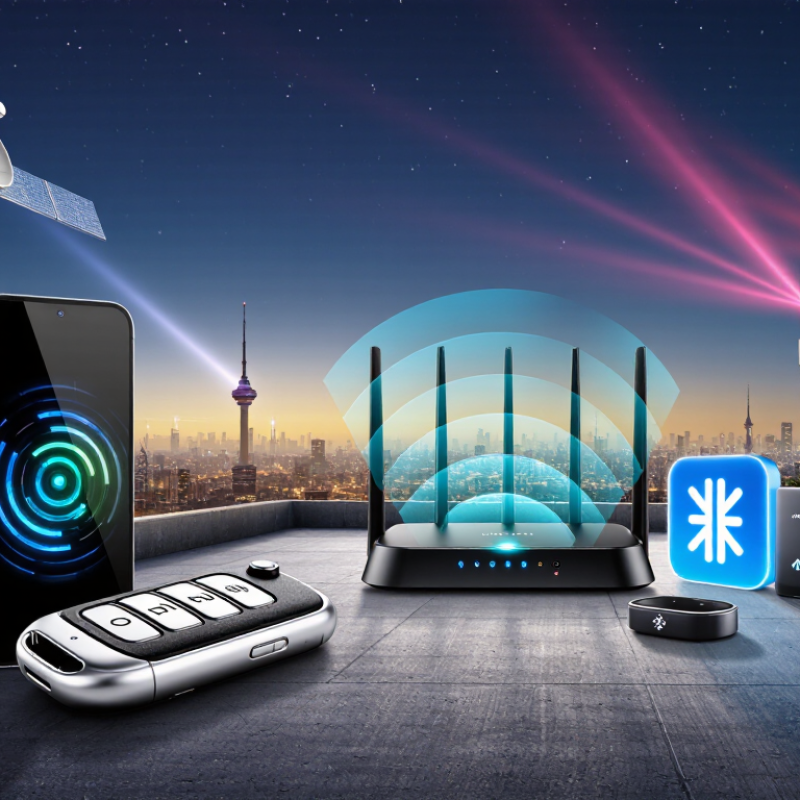
Radio frequency technology quietly shapes everyday life, from a car key fob beside a driveway to a satellite crossing the night sky. RF Communication carries information through electromagnetic waves, using different frequencies, power levels, antennas, and modulation methods. This outline examines ten major types, including AM, FM, HF, VHF, UHF, microwave, satellite, cellular, Wi-Fi, and Bluetooth communication.

The classification is practical, not absolute. Some systems overlap. Cellular networks use microwave frequencies, while Wi-Fi and Bluetooth share unlicensed spectrum. That detail matters when comparing range, bandwidth, interference, latency, and power consumption. The International Telecommunication Union’s Radio Regulations provide the global framework for spectrum use. Ericsson’s Mobility Report, November 2024, projects mobile data traffic will continue rising sharply as 5G adoption expands. GSMA’s The Mobile Economy 2024 also reports billions of mobile connections worldwide, showing RF infrastructure remains central to digital access.

Theodore S. Rappaport, a leading wireless communications researcher, has said, “Wireless communications is the most important technology of the 21st century.” His statement captures the field’s influence, although it may sound too broad today. Fiber optics, wired networks, and edge computing also deserve recognition. A reliable comparison must therefore avoid declaring one RF type universally superior. Each method solves a different engineering problem. A handheld Bluetooth sensor needs low power. A television transmitter needs broad coverage. A satellite link needs careful atmospheric and distance planning. The following sections use these real-world contrasts to explain where each RF Communication type works best, where it struggles, and why engineers still choose it.
What Are the Top 10 Types of RF Communication?

Defining RF Communication and Its Role in Wireless Technology

What Are the Top 10 Types of RF Communication?

RF communication uses electromagnetic waves to carry information without physical cables. The International Telecommunication Union generally places radio frequencies between 3 kHz and 300 GHz. A transmitter converts voice, data, or control signals into modulated waves. An antenna then radiates them through air, space, or buildings. Distance, frequency, bandwidth, and obstacles shape the final result.

The ten common types are AM, FM, HF, VHF, UHF, microwave, satellite, cellular, Wi-Fi, and Bluetooth communication. AM supports wide-area broadcasting but can suffer from electrical noise. FM provides clearer audio over shorter regional ranges. HF can travel beyond the horizon through ionospheric reflection. VHF and UHF support television, aviation, public safety, and local radio links. Microwave systems carry high-capacity data between fixed sites. Satellite links extend coverage across oceans and remote terrain. Cellular networks connect moving users through coordinated base stations. Wi-Fi serves local wireless networks, while Bluetooth handles short-range device connections. These categories overlap. That is the untidy part.

The ITU Facts and Figures 2024 report estimates that 5.5 billion people used the Internet in 2024. Wireless access enables much of that participation. The GSMA Mobile Economy 2024 report estimates that mobile technologies and services contributed 6.3% of global GDP in 2023. RF is therefore infrastructure, not merely a signal. Engineers still face trade-offs involving interference, spectrum scarcity, energy use, and indoor coverage. A neat top ten can mislead. Real systems often combine several RF methods within one network.

What Are the Top 10 Types of RF Communication?

RF communication uses electromagnetic waves to transmit information wirelessly. The chart compares representative operating frequencies for ten widely used RF communication categories. Frequencies are nominal examples within commonly allocated bands, not a market ranking.

How to read the chart: The logarithmic scale shows how RF systems range from medium-frequency broadcasting to millimeter-wave satellite and radar applications.

How RF Communication Systems Are Classified

What Are the Top 10 Types of RF Communication?
How RF Communication Systems Are Classified

RF communication is classified by range, frequency, mobility, network design, and application. The ten common types are broadcast radio, television transmission, cellular networks, Wi-Fi, Bluetooth, satellite links, microwave backhaul, radio navigation, RFID or NFC, and industrial, scientific, and medical communication. These categories overlap. A cellular device may also use Wi-Fi, satellite positioning, and short-range identification.

Range gives the clearest starting point. Broadcast systems cover wide areas, while Bluetooth usually serves a room. Microwave links connect fixed sites with narrow beams. Satellites extend coverage across oceans and remote regions. Cellular systems prioritize mobility and capacity. The ITU Radio Regulations classify services by purpose, including fixed, mobile, broadcasting, satellite, and radionavigation services. The 2024 GSMA Mobile Economy report estimated 4.7 billion mobile internet users in 2023, showing why spectrum efficiency matters. That figure is useful, but user counts do not fully measure RF traffic or network quality.

Tips: Check frequency, bandwidth, range, antenna type, and interference conditions before choosing a category. Engineers should also review local allocations and power limits. The ITU’s World Radiocommunication Conference 2023 revised international spectrum frameworks, yet national rules still differ. Real environments are messy. Walls, weather, reflections, and crowded channels can change performance. Classification helps, but it should not replace field testing.

What Are the Top 10 Types of RF Communication? — How RF Communication Systems Are Classified

No. RF Communication Type Primary Classification How Information Is Encoded Typical Frequency Context Common Applications Main Advantages Key Limitations
1 Amplitude Modulation (AM) Analog modulation The carrier amplitude varies in proportion to the information signal while the carrier frequency remains substantially constant. Used across low-, medium-, and high-frequency radio services; the exact band depends on regulation and application. Broadcast radio, aviation voice communication, marine communication, and long-distance low-data-rate links. Simple transmitters and receivers; can cover long distances at lower frequencies. Susceptible to amplitude noise, fading, and inefficient use of transmitted power and spectrum.
2 Frequency Modulation (FM) Analog modulation The carrier frequency changes according to the instantaneous value of the information signal, while carrier amplitude remains nearly constant. Commonly used in VHF and UHF systems, although FM can be implemented at many RF frequencies. High-fidelity audio broadcasting, two-way voice radios, telemetry, and industrial control links. Better resistance to amplitude noise than AM and good audio quality when sufficient bandwidth is available. Generally requires more bandwidth than AM and can suffer from capture effects and reduced coverage beyond line of sight.
3 Phase Modulation (PM) Analog modulation The carrier phase varies with the information signal. PM is closely related to FM because phase and frequency changes are mathematically linked. Used in various VHF, UHF, microwave, and satellite communication systems. Analog telemetry, narrowband voice systems, instrumentation, and as a foundation for digital phase-shift keying. Constant-envelope implementations can support efficient power amplification and good noise performance. Requires careful phase tracking; phase ambiguity and multipath effects can complicate receiver design.
4 Frequency-Shift Keying (FSK) Digital modulation Digital symbols are represented by selecting between two or more discrete carrier frequencies. Found from low-frequency control links through VHF, UHF, and microwave data systems. Low-power telemetry, paging, industrial sensors, utility meters, and robust machine-to-machine links. Reliable noncoherent detection is possible, and constant-envelope forms work well with efficient power amplifiers. Uses more bandwidth than some higher-order schemes and may provide lower data efficiency in a crowded channel.
5 Phase-Shift Keying (PSK) Digital modulation Digital symbols are represented by discrete changes in the carrier phase. Binary, quadrature, and higher-order forms are common. Widely used in satellite, cellular, microwave, navigation, and spread-spectrum systems. Digital radio, satellite links, telemetry, navigation signals, and wireless data transmission. Good power efficiency and strong performance in low-noise channels; supports several data-rate options. Requires accurate carrier and phase synchronization; multipath and phase noise can increase error rates.
6 Quadrature Amplitude Modulation (QAM) Digital amplitude and phase modulation Each symbol uses a combination of amplitude and phase states to transmit multiple bits per symbol. Common in broadband radio, microwave backhaul, cable, and high-capacity wireless systems. High-speed fixed wireless links, broadband access, digital television, and data backhaul. High spectral efficiency and flexible data rates through different constellation sizes. More sensitive to noise, interference, nonlinear amplification, and fading than constant-envelope modulation.
7 Orthogonal Frequency-Division Multiplexing (OFDM) Multicarrier modulation Data is divided among many closely spaced orthogonal subcarriers, often using PSK or QAM on each subcarrier. Used in wideband systems across microwave, UHF, SHF, and millimeter-wave bands. Broadband wireless access, digital broadcasting, high-speed local networks, and modern cellular radio. Handles frequency-selective multipath well and enables flexible subcarrier allocation. Has a high peak-to-average power ratio and requires accurate timing and frequency synchronization.
8 Direct-Sequence Spread Spectrum (DSSS) Spread-spectrum technique Each information symbol is multiplied by a faster pseudorandom chip sequence, spreading the signal over a wider bandwidth. Can operate in many licensed or unlicensed RF bands, subject to applicable spectrum rules. Navigation, secure or interference-resistant links, low-power sensor networks, and selected data systems. Improves resistance to narrowband interference and supports processing gain through despreading. Requires code synchronization and occupies more bandwidth than the original information signal.
9 Frequency-Hopping Spread Spectrum (FHSS) Spread-spectrum technique The carrier rapidly changes among a sequence of frequency channels known to the transmitter and receiver. Implemented in various VHF, UHF, and microwave bands, depending on local regulations. Short-range control links, industrial wireless systems, tactical radios, and interference-tolerant networks. Reduces the effect of narrowband interference and can provide frequency diversity. Needs precise hop timing and channel coordination; available instantaneous bandwidth may be limited.
10 Ultra-Wideband (UWB) Communication Wideband signaling Uses very short pulses or a signal occupying a very large bandwidth relative to its center frequency; regulatory definitions vary by jurisdiction. Usually associated with short-range operation in regulated microwave and millimeter-wave spectrum. Short-range ranging, positioning, radar sensing, indoor localization, and high-speed device-to-device links. Very fine time resolution, low power spectral density, and strong potential for precise ranging. Typically has limited range, requires wideband antennas and receivers, and must comply with strict spectral emission limits.

Note: These categories can overlap. A practical RF system may combine a modulation method, a multicarrier or spread-spectrum technique, a multiple-access method, and a specific frequency band.

The Ten Main Types of RF Communication

The Ten Main Types of RF Communication

RF communication uses electromagnetic waves to transfer voice, data, or control signals through air. Amplitude modulation, or AM, changes signal strength and suits simple broadcast links. Frequency modulation, or FM, varies frequency and handles noise better. Phase modulation, or PM, shifts the signal’s phase for accurate data transfer. Single-sideband communication saves bandwidth and supports long-distance voice links. It needs careful tuning.

Digital systems offer five additional approaches. Amplitude shift keying, or ASK, changes carrier strength between symbols. Frequency shift keying, or FSK, switches between defined frequencies. Phase shift keying, or PSK, changes phase to represent binary data. Quadrature amplitude modulation, or QAM, changes amplitude and phase together, providing high data rates. Orthogonal frequency-division multiplexing, or OFDM, divides data across many closely spaced carriers. Spread-spectrum communication distributes energy across a wider band, improving resistance to interference and signal interception. UWB, or ultra-wideband communication, uses extremely broad pulses for short-range, precise transmissions.

In practical testing, antenna placement can matter as much as modulation choice. A poorly matched antenna wastes power. Obstacles also create fading, even when calculations appear perfect. Engineers should compare bandwidth, range, noise tolerance, power use, and hardware complexity before selecting a method. No type wins every application. Real environments remain less predictable than laboratory measurements.

Key Differences in Range, Frequency, and Applications

What Are the Top 10 Types of RF Communication?

Radio-frequency communication includes ten widely used types, each with different range, frequency, and practical uses. Amplitude modulation, or AM, commonly supports long-distance voice broadcasting at lower frequencies. Frequency modulation, or FM, offers clearer audio across local and regional areas. Phase modulation, or PM, changes the carrier phase and supports reliable digital signaling. Shortwave communication can travel across continents by reflecting from the ionosphere. Its performance can change with weather and solar activity.

Very high frequency, or VHF, suits marine radios, aviation, and outdoor mobile communication. Ultra-high frequency, or UHF, works well for television, handheld radios, and building penetration. Microwave links use higher frequencies and directional antennas for point-to-point data transmission. Satellite communication extends coverage across oceans and remote regions, although signal delay can matter. Cellular communication uses licensed frequency bands, dense networks, and controlled handoffs for moving users. Wi-Fi and Bluetooth operate over shorter distances, supporting local internet access and device connections.

Range is not determined by frequency alone. Power, antenna height, obstacles, bandwidth, and receiver sensitivity also shape real performance. In field testing, a lower-frequency signal may travel farther, while a higher-frequency link carries more data. That trade-off is easy to overlook. An indoor UHF signal can weaken behind concrete walls, despite its useful penetration. Engineers should measure the actual environment instead of trusting theoretical range tables. No single RF type wins everywhere.

Choosing the Right RF Communication Type for a Specific Use

What Are the Top 10 Types of RF Communication?

Choosing the right RF communication type starts with distance, data volume, power, and interference. The common options include cellular, Wi-Fi, Bluetooth, Zigbee, LoRaWAN, RFID, NFC, satellite, two-way radio, and broadcast radio. Each solves a different field problem. A warehouse tag may need RFID, not cellular. A remote sensor may favor LoRaWAN because it sends small data packets over long distances. A video terminal needs much higher throughput.

Industry data supports this practical approach. The GSMA Mobile Economy 2024 report projects 5.5 billion 5G connections by 2030, showing strong demand for high-speed mobile links. However, high speed often brings greater power use and network dependence. The IoT Analytics State of IoT 2024 report estimates 18.8 billion connected IoT devices worldwide in 2024. That growth makes low-power RF choices increasingly important. Small batteries expose weak design decisions quickly.

Site testing still matters more than a specification sheet. Measure walls, metal surfaces, antenna height, and peak traffic. Use satellite links where terrestrial coverage fails. Choose two-way radio for immediate voice coordination. NFC fits short-range identity checks. Broadcast radio remains useful for one-to-many delivery. My field experience suggests that engineers often overvalue maximum range. They sometimes overlook maintenance, licensing requirements, and indoor dead zones. The “best” RF type can change after one concrete wall or a wet storage area enters the design. Forecasts guide decisions, but measurements should have the final voice.