
585.204.6770
sale@sanblueplastics.com
Your Source for Trays!
Stainless Steel Meat Hooks may look simple, but their shape affects how securely meat hangs, turns, and drains. This guide introduces ten common types, from familiar S-hooks and J-hooks to gambrel, double-prong, and spreader designs. Each serves a different task. A compact hook may suit smaller cuts, while a wider design can provide more balance for larger pieces. The right choice depends on the load, available hanging space, and how the hook will be cleaned and stored.
Small details matter. Wire thickness, weld quality, surface finish, and stated load capacity are worth checking before purchase. Stainless steel grades also differ in corrosion resistance, so product specifications should be clear rather than assumed from a shiny appearance. In practical use, smooth edges and easy-to-clean joints can make a noticeable difference around meat and moisture. Fit comes first. There is no universal best hook, and even a careful comparison cannot fully predict how a design will feel in a cold, wet hand. The overview below explains what each type is generally suited for and what to inspect, helping readers compare options with greater confidence. Always follow the maker’s load guidance and maintain hooks according to their instructions.
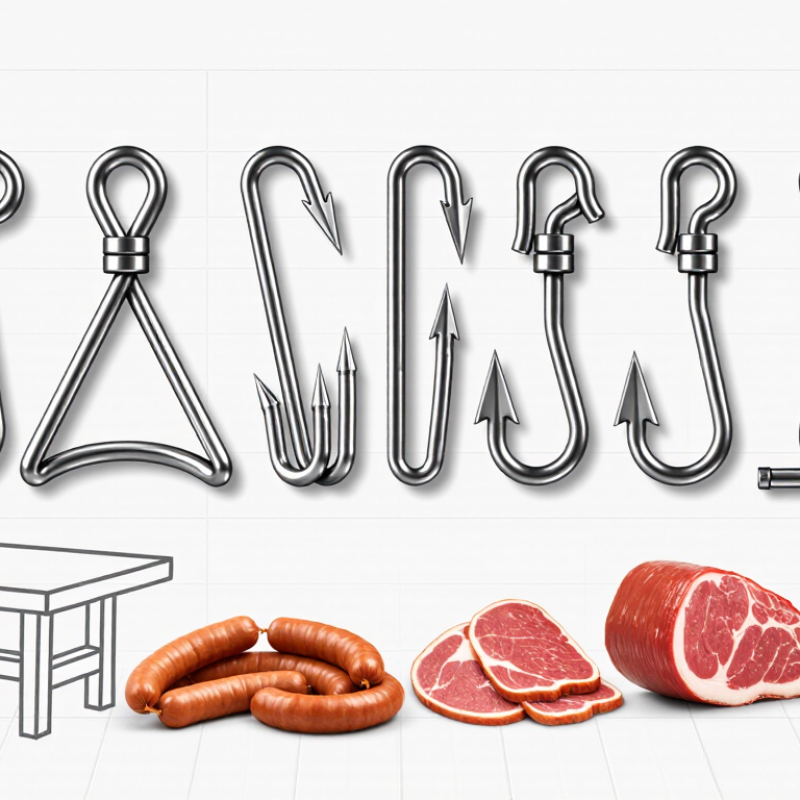
Meat hooks are easier to compare by their shape and intended task than by name alone. Common designs include straight single-point hooks, curved single-point hooks, double-point hooks, S-hooks, J-hooks, gambrel hooks, spreader hooks, swivel hooks, ring hooks, and hand hooks. The categories overlap. A gambrel, for example, often uses two points to support a cut across a wider area.
Shape affects how a hook engages the load. A curved point can help hold meat securely, while a straight point offers a simple entry angle. S- and J-shaped hooks are often used for hanging or transferring items between supports. Gambrel and spreader designs keep two contact points apart; this can improve balance when the load suits the hook’s width. Swivel models allow rotation, while ring-style forms provide a closed hanging point. Small differences matter.
Function matters just as much. Hand hooks are designed for manual handling, while rail hooks hang from compatible overhead systems. Check the hook’s rated capacity, point finish, and dimensions before use; stainless steel alone does not indicate strength. Inspect it for bending, cracks, or a loose swivel. A close visual check helps. I would not assume two hooks with similar shapes perform alike, since gauge, weld quality, and intended load can vary.
What Are the Top 10 Types of Stainless Steel Meat Hooks?
Basic Designs: Straight, S-Shaped, J-Shaped, and Double-Prong Hooks
Straight hooks hang cuts in a clean vertical line, making them useful on rails or inside chillers. S-shaped hooks offer two contact points: one end holds the rail, while the other carries the load. They are quick to move, but can swing when bumped. J-shaped hooks provide a deeper curve for a single hanging point. Double-prong hooks grip with two points and can help steady wider cuts. No shape is perfect; weight, cut size, and rail spacing all matter. USDA ERS’s Food Availability (Per Capita) Data estimates U.S. red-meat and poultry availability at roughly 225 pounds per person in 2023. That scale makes dependable handling equipment important, though the figure does not determine hook size.
Tips: Check the hook’s rated capacity and inspect welds, points, and bends before use. Choose corrosion-resistant stainless steel suited to your cleaning routine. The FDA Food Code calls for food-contact surfaces to be durable, corrosion-resistant, and easily cleanable. Keep hooks free of deep scratches and dried residue. A double-prong hook may feel more stable, but only when both points sit securely in the cut. Test the fit carefully.
| No. | Hook Type | Basic Design | Typical Use | Practical Considerations |
|---|---|---|---|---|
| 1 | Straight Single-Prong Hook | A straight shank with one pointed or tapered end and a hanging end or eye. | Hanging cuts of meat from a rail, rack, or overhead support. | Simple to handle and clean. Choose a hook size and wire or bar thickness suited to the load and support. |
| 2 | S-Hook | A curved hook with an upper and lower opening, forming an S-like profile. | Connecting a meat cut or gambrel to a rail, rod, or other hanging point. | Easy to attach and remove; an open hook can shift if bumped, so use an appropriate support and secure handling. |
| 3 | J-Hook | A single curved hook with a long shank and a J-shaped lower end. | Suspending individual cuts or carcass sections from a compatible rail or rack. | The open curve allows quick loading. Confirm that the curve and opening fit the support and the intended product. |
| 4 | Double-Prong Hook | Two points extend from a shared shank or crosspiece. | Holding a larger cut or providing two contact points for more stable suspension. | Spacing and prong shape affect how the load sits. Avoid overloading or using damaged or bent prongs. |
| 5 | Gambrel Hook | A bar or spreader with a hook at each end, often suspended from a central hook or loop. | Spreading and hanging a carcass or paired sections from an overhead support. | Provides a wider suspension point than a single hook. The bar, end hooks, and central connection all need suitable capacity. |
| 6 | Swivel Hook | A hook connected to a rotating joint, often with a loop or eye for suspension. | Hanging products where rotation can help with positioning, inspection, or handling. | The swivel adds a moving component that should be checked for smooth operation, wear, and cleanability. |
| 7 | Swivel S-Hook | An S-shaped hook combined with a rotating connection. | Suspending a cut from a rail while allowing it to turn during handling or processing. | Check both the open hook ends and swivel joint before use; moving parts can require extra inspection. |
| 8 | Eye-and-Point Hook | A closed eye or loop at one end and a pointed meat-holding end at the other. | Hanging individual cuts from a compatible rail, ring, or fixed attachment point. | The closed eye helps prevent separation from a compatible connector, while the pointed end must be handled carefully. |
| 9 | Smokehouse Hook | A hanging hook configured for use with smokehouse rods, trolleys, or racks; shapes vary by system. | Suspending meat or processed products in a smokehouse or similar controlled environment. | Verify compatibility with the rack and process conditions. Clean and dry the hook according to food-handling procedures. |
| 10 | Multi-Prong Hook | Three or more prongs arranged around or along a shared shank or mounting point. | Supporting products that benefit from several contact points, such as selected larger or irregular cuts. | Prong arrangement affects stability and product contact. Use only for products and loads appropriate to the hook design. |
Selection note: Stainless steel grade, hook dimensions, construction, weld quality, and rated load vary by product. Confirm food-contact suitability, load limits, support compatibility, and cleaning requirements before use.
Gambrel hooks spread a carcass across two support points, helping keep it balanced during lifting and chilling. Their curved arms should have smooth, fully finished welds, with no sharp burrs that trap residue or snag gloves. Check the rated load, too; appearance alone cannot confirm safe capacity. H-style hooks offer a compact, stable option for hanging smaller cuts or separating items on a rail. Their crossbar can be awkward to scrub if it meets the upright at a tight angle. That detail matters.
Multi-prong hooks grip several smaller pieces at once, but crowded prongs can complicate cleaning and increase the chance of uneven loading. Choose a configuration that leaves enough space to inspect every contact point. The USDA National Agricultural Statistics Service reported 55.5 billion pounds of commercial red meat production in its 2023 Livestock Slaughter report. That figure reflects the scale of handling in the sector, not a recommended hook load. Match hook capacity to the actual product weight and lifting method, and review the supplier’s load documentation. Stainless steel grades also differ: 304 is common in food equipment, while more corrosive environments may call for a more resistant grade. I would still verify the finish and weld quality in person. A specification sheet cannot show every rough edge.
Poultry hooks are usually slimmer, with a tighter curve for holding smaller birds by the leg or neck area. Their narrow profile helps keep birds spaced apart on a rail, though a hook placed poorly can tear delicate skin. Butcher hooks are often heavier, with a broader opening suited to larger cuts and brisk handling. Check the hook’s rated capacity; appearance alone does not tell you how much weight it can safely hold. Smokehouse hooks may have longer shanks or shapes that leave room between pieces. That spacing helps smoke circulate around meat instead of pooling in crowded gaps. Small differences matter.
Stainless steel resists rust, but it is not maintenance-free. Food residue can collect near bends and joints, so wash hooks promptly and dry them fully. A smooth finish is easier to clean, while a worn or bent hook deserves a closer look. No design is perfect. The best choice depends on the product, rail setup, and how often hooks are handled.
Tips: Match hook size to the cut, keep pieces from touching, and inspect points and bends before use. Wear cut-resistant gloves when handling sharp hooks. If a hook slips or twists under a normal load, stop using it and reassess the setup.
A meat hook should fit the cut before it fits the rail. For carcasses and large quarters, a heavy-duty S-hook or gambrel spreads the load and reduces rolling. A narrow single-point hook suits smaller cuts, while a broad or multi-prong design can grip awkward shapes. Keep the tip smooth and polished; burrs can tear meat and trap residue. A useful detail: the hook’s bend should seat securely on the trolley without blocking nearby hooks.
Match capacity to the heaviest expected load, not the average. NIOSH’s Revised Lifting Equation uses a 51-pound load constant for ideal two-handed lifting, but that figure is not a hook rating. Check the hook’s stated working load limit and consider shock loading, spacing, and how workers lift or transfer it.
Stainless grade matters too. Nickel Institute technical guidance describes molybdenum as a key addition that improves resistance to pitting; 316 commonly contains about 2–3% molybdenum, unlike standard 304. For frequent washdowns or salty brines, that added resistance may justify the cost.
Not always. A well-finished 304 hook can suit less corrosive rooms, but inspect welds, bends, and surface damage after cleaning. In practice, hooks that look identical may behave differently when overloaded or poorly stored. Check the supplier’s test documentation, then trial the design with the actual cut and trolley before ordering in quantity.