
585.204.6770
sale@sanblueplastics.com
Your Source for Trays!
Top 10 Coil Transfer Cart Manufacturers Worldwide
Moving steel coils across a plant floor demands more than a powerful motor. A Coil Transfer Cart must carry heavy loads safely, align with production equipment, and operate reliably through repeated shifts. In a busy mill, the route may cross uneven joints, narrow aisles, or areas exposed to heat and metal dust. Small design choices matter.
This guide introduces ten manufacturers serving coil-handling operations around the world. Their carts may differ in drive systems, steering, power supply, load capacity, and control options. Some models use rail guidance; others travel freely across the floor. The right choice depends on the coil dimensions, travel distance, floor condition, and how the cart connects with cranes or processing lines. Details matter. A catalog rarely tells the whole story.
When comparing suppliers, buyers should examine documented load ratings, safety features, customization capabilities, service coverage, and relevant project experience. Ask for technical drawings and clear operating limits, then verify that proposed specifications match the actual site. Published product information can vary in detail, and manufacturer claims are not always directly comparable. Not always. This overview is a starting point, not a universal ranking or a substitute for engineering review. Even experienced teams can overlook a turning radius or charging constraint. A careful comparison helps identify manufacturers worth contacting and questions worth asking before a Coil Transfer Cart enters service.
What Coil Transfer Carts Are and How They Work
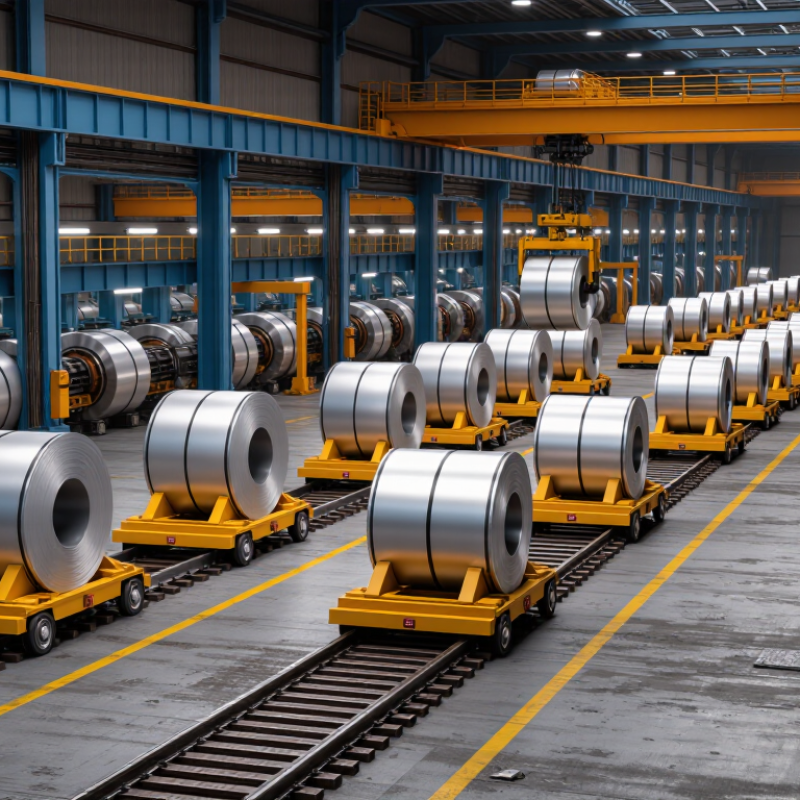
A coil transfer cart moves heavy steel or aluminum coils between production stations, storage areas, and loading points. Unlike a standard flatbed cart, it has a shaped cradle that helps keep the round load from rolling. The cradle may be lined with steel, rubber, or other wear-resistant material, depending on the coil and operating conditions. Stability matters.
Most carts run on rails or use wheels on a prepared floor. A battery-powered drive, cable system, or manual tow can provide movement. The operator positions the coil with a crane or lifting device, checks that it sits securely, then moves the cart along its route. Controls may include speed adjustment, braking, and emergency stops. Exact features vary by load capacity and site layout.
Good operation depends on more than the cart’s rated capacity. Coil dimensions, floor condition, turning space, and travel distance all affect performance. A low speed can improve control, but it may slow production. That trade-off is easy to overlook. Before choosing equipment, teams should confirm the load’s weight and center of gravity, then review the route with operators and maintenance staff. Real sites are rarely perfect, so a practical trial can reveal problems that a drawing misses.
Top 10 Coil Transfer Cart Manufacturers Worldwide – What Coil Transfer Carts Are and How They Work
Coil transfer carts are industrial vehicles designed to move heavy steel, aluminum, or other wound-material coils between work areas. The table below summarizes ten practical design and operating criteria for evaluating coil-cart equipment; it does not rank or identify manufacturers. Actual capacities and configurations depend on the load, route, duty cycle, and site conditions.
| No. | Evaluation dimension | Relevant design data | How it works | What to verify |
|---|---|---|---|---|
| 1 | Rated load capacity | Specified as a maximum working load; capacity is selected for the actual coil mass and handling arrangement. | The chassis, wheels, drive system, and supporting structure carry the coil and cart during travel. | Confirm the cart rating covers the heaviest coil, any fixture, and the required operating conditions. |
| 2 | Coil support and restraint | A shaped saddle or cradle supports the coil; the required geometry depends on coil diameter, width, and orientation. | The cradle distributes contact forces and helps keep the coil from rolling while the cart moves. | Check coil dimensions, contact surfaces, restraints, and whether the eye is horizontal or vertical. |
| 3 | Travel path | Carts can be designed for rails or for travel on a prepared floor, depending on the application. | Rail-guided wheels follow a fixed route; floor-running carts use steering and wheel systems suited to the site surface. | Assess route length, turns, floor condition, gradients, crossings, and required positioning accuracy. |
| 4 | Power supply | Common options include onboard batteries and site-fed systems such as cable reels or conductor arrangements. | Electrical power drives the traction motors and, where fitted, the controls and auxiliary equipment. | Compare operating distance, charging or supply infrastructure, duty cycle, and maintenance access. |
| 5 | Drive and steering | Drive layout and steering configuration are selected to suit the cart size, load, route, and required maneuverability. | The drive system turns the wheels; steering may be fixed for a straight route or configured to support turning on the site. | Review turning space, wheel loads, travel speed, and whether the route requires straight-line or multidirectional movement. |
| 6 | Loading and unloading interface | The transfer height and support layout must match the crane, forklift, coil car, or production equipment used at each station. | A coil is placed onto or removed from the cart using compatible material-handling equipment or an integrated lifting feature. | Check clearances, alignment, lift points, transfer height, and the sequence of handoffs. |
| 7 | Control method | Control may be operator-driven, remote-controlled, or integrated with site automation, depending on the system design. | Commands regulate starting, stopping, direction, and, where supported, route or position functions. | Confirm operator visibility, communication method, emergency-stop access, and compatibility with plant controls. |
| 8 | Braking and stopping | Braking is designed for the cart’s load, speed, route, and operating environment; the specific arrangement varies by model. | The braking system slows or holds the cart when commanded and may also engage under defined fault conditions. | Request stopping-distance and holding-capability information for the intended load and route. |
| 9 | Safety provisions | Risk controls may include emergency stops, warning devices, guarding, interlocks, and obstacle-detection features where specified. | Safety devices alert people, stop motion, or prevent certain movements when configured conditions are detected. | Evaluate the site risk assessment, pedestrian interaction, visibility, and applicable local requirements. |
| 10 | Duty cycle and maintenance | Service needs depend on operating frequency, environment, power system, wheel and rail conditions, and component design. | Routine inspection helps keep the drive, brakes, wheels, electrical equipment, and coil-support surfaces in working condition. | Ask for the recommended inspection schedule, wear-part list, service access, and expected operating duty. |
Note: The listed options describe common engineering considerations, not specifications for a particular manufacturer or model. Confirm final ratings and safety requirements with the equipment supplier and a qualified site engineer.