Top Divider Boxes Suppliers for Global Buyers
A shipment of glass vials, spare parts, or cosmetics can arrive with one item cracked and an entire order delayed. Divider boxes help limit contact between products, keep units organized, and make packing more repeatable. But the box is only as dependable as its board grade, internal fit, and production consistency.
The market context is substantial. Grand View Research valued the global corrugated packaging market at USD 284.4 billion in 2023 and projected a 5.8% compound annual growth rate from 2024 to 2030. This broad category includes far more than divider boxes, so it should not be mistaken for a divider-specific forecast. Still, it signals a large, active supplier landscape. For global buyers, comparing manufacturers means looking beyond a low quoted price. Ask about sample testing, dimensional tolerances, material specifications, order quantities, lead times, and export packing. A divider that shifts during transit may look fine on a desk.
Details matter.
This guide examines suppliers through practical questions: Can they adapt cell sizes to fragile or irregular products? Do they document material choices and inspection procedures? Can their delivery plans withstand seasonal demand and long-distance shipping? Public market reports offer useful context, but they cannot verify an individual factory’s performance. Buyers should request recent samples and confirm specifications before committing. No scorecard is perfect; even a careful review can miss a production change. That is worth remembering. The right supplier is not simply the one with the broadest catalog, but the one whose boxes perform reliably in the buyer’s actual packing line and supply chain.
What Divider Box Suppliers Offer: 32 ECT Corrugated Board and Custom Cells
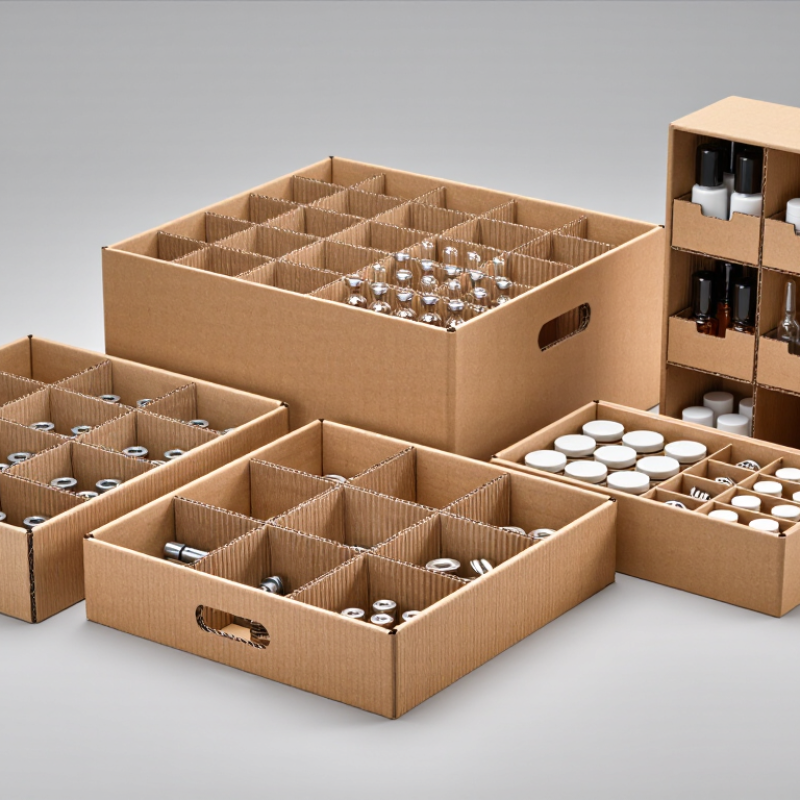
Divider boxes are more than sheets of corrugated board folded into cells. A capable supplier can size each compartment to limit movement, separate fragile surfaces, and make packing easier. For buyers, 32 ECT board is a useful starting specification: ECT measures edgewise compression strength, typically in pounds per inch. TAPPI T 811 describes a common test method. It does not, by itself, guarantee a finished box’s stacking or drop performance.
Custom cells should match the product’s dimensions, weight, and contact points. Ask suppliers for a sample with realistic tolerances, then test it with the actual packed goods. Check whether parts shift, corners rub, or dividers buckle under stacked weight. Small details matter. Moisture and long transit times can also affect corrugated performance, so a laboratory board rating is not the whole story.
The material choice has a recovery context, too. The U.S. Environmental Protection Agency’s 2018 Facts and Figures estimated that about 33 million tons of corrugated boxes were generated, with roughly 32 million tons recycled. That supports asking suppliers about recyclable, right-sized designs, while checking local collection practices. One caveat: more cells can improve separation but add material and packing steps. The best layout is not always the most elaborate one.
How to Match Divider Cell Dimensions to Product Size and Fragility
A divider box protects products only when each cell fits the item closely without squeezing it. Measure the product at its widest and tallest points, including caps, handles, or protective sleeves. Add modest clearance for loading and removal, but avoid oversized cells that let items shift. Small gaps matter. For fragile goods, check where the dividers touch: a firm edge against a thin glass wall can cause damage during vibration. Corrugated or foam partitions may soften contact, but their thickness reduces usable cell space. For irregular products, measure several samples; dimensions can vary more than expected.
Tips: Place one product in a sample cell and gently tilt the box. If it slides, reduce the clearance or add cushioning. If removal takes force, enlarge the cell slightly. Test it physically.
Before ordering at scale, pack a small trial batch and inspect it after normal handling and transport simulation. Look for scuffed surfaces, leaning products, crushed divider edges, and difficult unpacking. A cell that fits perfectly on paper may fail once packaging tolerances are included. I have seen teams focus on the product’s main body and forget a protruding nozzle or corner. That small oversight can make an otherwise sound layout unreliable. Revise the dimensions based on actual samples, not just drawings.
Top Divider Boxes Suppliers for Global Buyers - How to Match Divider Cell Dimensions to Product Size and Fragility
Use these practical starting dimensions to plan corrugated divider cells. Cell measurements are internal dimensions; allow for product variation, protective wraps, and the fit of the assembled box.
| Product Example |
Typical Product Size (L × W × H) |
Fragility |
Suggested Cell Size (L × W) |
Approx. Clearance per Side |
Divider Starting Specification |
Packing Consideration |
| Small glass jar |
70 × 70 × 100 mm |
High |
76 × 76 mm |
3 mm |
Double-wall corrugated board; approximately 4–6 mm thick |
Keep the jar from contacting neighboring items. Add a top pad where vertical movement is possible. |
| Wine bottle |
300 × 80 × 80 mm |
High |
86 × 86 mm |
3 mm |
Double-wall corrugated board; approximately 4–6 mm thick |
Use a full-height cell and secure the neck and base. Confirm the cell fits the bottle’s widest point. |
| Ceramic mug |
110 × 90 × 100 mm |
High |
98 × 118 mm |
4 mm |
Single-wall corrugated board; approximately 3–4 mm thick, with added cushioning if needed |
Orient the handle consistently and check that it does not press against a divider wall. |
| Cosmetic bottle |
45 × 45 × 125 mm |
Medium to high |
51 × 51 mm |
3 mm |
Single-wall corrugated board; approximately 3–4 mm thick |
Allow room for caps, pumps, or protective sleeves, which can increase the packed dimensions. |
| Small electronics accessory |
120 × 80 × 35 mm |
Medium |
128 × 88 mm |
4 mm |
Single-wall corrugated board; approximately 3–4 mm thick |
Use an antistatic inner package where the product requires it; the divider is not an antistatic barrier. |
| Metal component |
100 × 60 × 40 mm |
Low to medium |
106 × 66 mm |
3 mm |
Single-wall corrugated board; approximately 3–4 mm thick |
Check for sharp edges and sufficient restraint so parts cannot shift or abrade one another. |
| Egg-shaped glass ornament |
80 × 60 × 60 mm |
Very high |
70 × 90 mm |
5 mm, with shaped support |
Double-wall corrugated board; approximately 4–6 mm thick |
A rectangular cell alone may not prevent movement; use a fitted insert or cushioning to support the shape. |
Dimensioning note: Measure the largest packed product dimensions, including wrapping. Cell dimensions should account for divider thickness and assembly tolerances. Validate the completed pack with handling and transit testing, especially for fragile products.
ISTA 3A Testing: Parcel Packages Weighing Up to 70 kg (150 lb)
For parcel shipments weighing up to 70 kg (150 lb), ISTA 3A testing examines how a packaged product may respond to typical distribution hazards. The test sequence can include drops, vibration, and other conditioning steps, depending on the package type. Small, flat, elongated, and standard packages may follow different procedures. Check the applicable protocol before preparing samples.
Divider boxes need testing as complete shipping systems, not as isolated inserts. A partition may keep glass jars apart, yet still allow movement if its slots are too loose. Measure the product gaps, divider fit, board thickness, and carton closure. Then test the packed box with the actual contents and cushioning. Small details matter.
A practical evaluation records damage, product movement, and changes to the box after each test stage. Photographs help, especially when a divider bends at a corner or a tab slips out of place. A neat sample is not enough. Test more than one sample when possible, and document any design changes. Passing results support a particular package configuration; they do not guarantee identical performance after materials or packing methods change. Even a sturdy-looking divider may need another revision.
Top Divider Boxes Suppliers for Global Buyers — ISTA 3A Package Weight Scope
ISTA 3A applies to individual packaged products weighing up to 70 kg (150 lb) for parcel delivery. The package weights shown are illustrative reference points, not test results.
Packages above 70 kg are outside the stated weight scope of ISTA 3A. Confirm the applicable test procedure for the product and distribution environment.
Supplier Quality Checks: ISO 9001:2015, QC Records, and Sampling
Top Divider Boxes Suppliers for Global Buyers
A supplier’s ISO 9001:2015 certificate is a useful starting point, not proof that every divider box will meet specification. Check the certificate’s scope, site address, expiry date, and issuing body. Then compare its quality procedures with real production records. The ISO Survey 2022 reported 1,265,216 ISO 9001 certificates across 189 countries, showing how widely the standard is used. Certification alone cannot reveal how carefully a factory controls board thickness, slot width, or glue application.
Ask for recent inspection records tied to actual production batches. Useful details include measurements, defect counts, corrective actions, and equipment calibration dates. Look for traceability from incoming paperboard to packed cartons. A sample record should identify who checked it and when. Paper can look tidy. The factory floor may tell a different story.
Sampling should match the order’s risk and size. Ask whether the supplier uses a documented plan, such as ISO 2859-1, and agree on acceptance limits before production. Inspect samples for slot fit, edge damage, and divider stability inside a representative carton. Keep photos and measurements. One sample is not a trend. Even a sound sampling plan can miss defects, so review repeat-order performance and complaint records too. A small weakness here can matter.
Global Freight Planning: A 20-Foot Container Holds About 33 m³
Top Divider Boxes Suppliers for Global Buyers
Global Freight Planning: A 20-Foot Container Holds About 33 m³
A standard 20-foot dry container offers about 33 m³ of internal volume, according to commonly published container specifications. Treat this as a planning ceiling, not guaranteed usable space. Not all cubic metres are practical. Door clearance, uneven carton shapes, and safe stacking reduce the loadable volume. For divider boxes, measure the assembled carton and its inserts, not only the flat blank. A few centimetres of extra height across many cartons can disrupt a planned stack. Check the container’s actual dimensions and payload limits before confirming quantities.
UNCTAD’s Review of Maritime Transport 2024 reports that global maritime trade grew by 2.4% in 2023. For global buyers, even modest growth makes careful freight planning worthwhile. Calculate carton volume, then test the loading pattern against container dimensions. Keep dividers from bowing under stacked weight, and leave room for handling where needed. A neat spreadsheet is helpful, but a physical sample load can expose awkward gaps. I would not assume a perfect fit from volume calculations alone. Mixed carton sizes often waste space, even when their combined volume looks right. Recheck the final packing plan after production changes.