
585.204.6770
sale@sanblueplastics.com
Your Source for Trays!
Top Plastic Bins With Lids Manufacturers in China
China’s plastic storage sector serves retailers, warehouses, workshops, and households that need durable, repeat-use containers. Demand is shaped by practical details: a lid that stays seated, corners that resist impact, and bins that stack without slipping. Scale matters, but specifications matter more.
PlasticsEurope’s Plastics – the Fast Facts 2024 reports global plastics production of 413.8 million tonnes in 2023. The OECD’s Global Plastics Outlook (2022) estimates that packaging represented 40% of plastic waste generated in 2019. These figures do not measure storage-bin demand directly. They do show why buyers increasingly assess material use, product life, and end-of-life options. A reusable bin can help organize goods, but its real value depends on how long it lasts and whether its material and design suit the job.
This guide introduces leading manufacturers of plastic bins with lids in China and the factors worth checking before requesting a quotation. Compare dimensions, resin type, wall thickness, load capacity, lid design, and available customization. Ask for product drawings, sample units, and clear test details; a polished catalog is not proof of performance. That sounds simple. It is not always. Supplier claims can be difficult to compare when testing methods differ, so buyers should confirm what each specification actually means. The right manufacturer is not automatically the largest one. It is the supplier whose evidence, production capabilities, and communication match your intended use.
What Plastic Bins With Lids Are and How They Are Used
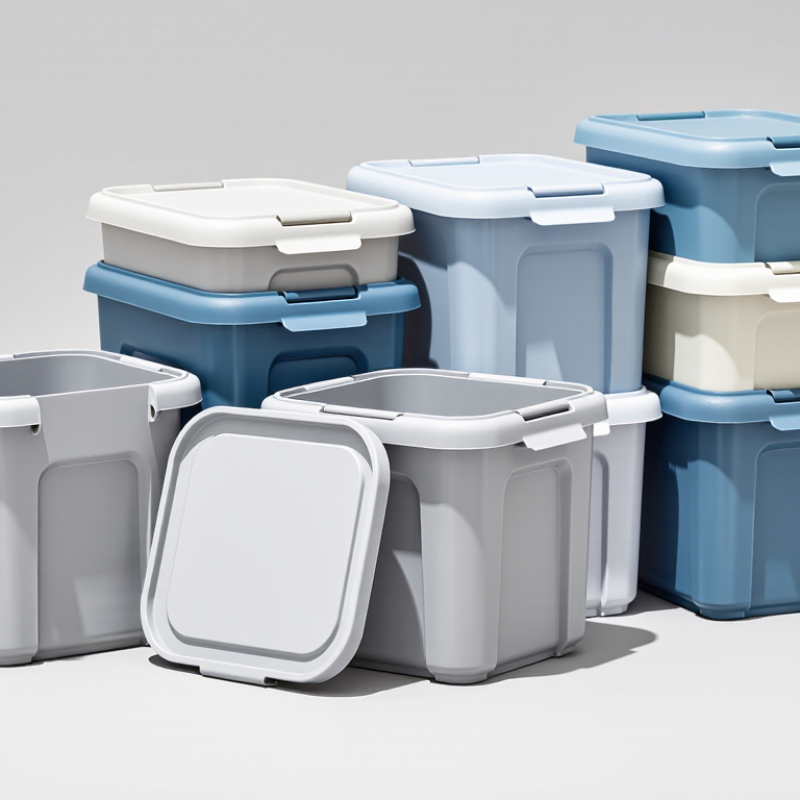
Plastic bins with lids are reusable containers designed to hold, organize, and protect items from dust, spills, and everyday handling. They are commonly made from polypropylene or polyethylene, though material and wall thickness vary by model. Clear sides make contents easier to identify, while opaque bins can limit light exposure. A lid may snap on, hinge open, or sit loosely over the rim. Small details matter. A lid can feel secure and still leave small gaps, so it should not be assumed to provide an airtight or waterproof seal.
These bins are used in homes, workshops, warehouses, and retail backrooms. People store seasonal clothing, craft supplies, hand tools, packaging materials, and small components in them. In a workshop, a labeled bin can keep screws separate from drill bits; on a shelf, stackable shapes can make better use of vertical space. Check the load rating before stacking, and match the bin’s dimensions to the shelf or storage area. Heavy contents can strain thin walls, especially when a full bin is lifted by its rim. That is easy to overlook. For items sensitive to moisture or temperature, review the product specifications and storage conditions rather than relying on the lid alone.
Top Plastic Bins With Lids Manufacturers in China - What Plastic Bins With Lids Are and How They Are Used
Plastic bins with lids are reusable containers for storing, organizing, protecting, or moving goods. The ranges below describe common product categories; actual dimensions, capacities, materials, and load ratings vary by design and manufacturer.
| Bin Type | Typical Capacity | Common Materials | Typical Lid Design | Common Uses | Details to Confirm with a Manufacturer |
|---|---|---|---|---|---|
| Small-parts storage bin | Approximately 1–20 L | Polypropylene (PP) or high-density polyethylene (HDPE) | Clip-on or hinged lid; some models have divided interiors | Organizing fasteners, components, craft supplies, and maintenance items | Internal dimensions, compartment layout, lid security, and compatibility with shelving |
| Stackable storage tote | Approximately 20–80 L | PP or HDPE | Separate snap-on lid, often with a recessed top for stacking | Warehouse picking, retail backrooms, household storage, and general-purpose handling | External dimensions, nesting or stacking design, wall thickness, and rated load |
| Large storage container | Approximately 80–200 L | HDPE or PP | Detachable lid or reinforced lid designed for stacking | Bulky goods, seasonal storage, equipment, and distribution operations | Handling method, lid strength, base design, and whether the container is intended for loaded stacking |
| Attached-lid distribution container | Commonly available in multiple sizes, from small totes to large containers | Usually PP or HDPE | Hinged or attached lid that stays connected to the container | Reusable transport, order fulfillment, closed-loop delivery, and return logistics | Foldability, nesting ratio, hinge durability, tamper-evident options, and pallet compatibility |
| Wheeled waste bin | Common municipal sizes include 120 L and 240 L | Typically HDPE | Top-hinged lid; wheeled versions commonly include a handle and axle | Household, commercial, and facility waste collection | Wheel and axle specifications, lifting compatibility, operating environment, and applicable local standards |
| Ingredient or bulk-storage bin | Varies by design; small and medium capacities are common | PP or HDPE; food-contact grades may be available | Close-fitting lid, sometimes with a dispensing opening | Storing dry ingredients, powders, or food-service supplies | Food-contact documentation for the intended market, cleaning requirements, seal design, and material suitability |
| General-purpose household bin | Approximately 10–100 L | PP or HDPE | Lift-off, snap-on, or hinged lid | Laundry, toys, linens, pantry organization, and garage storage | Dimensions, handles, ventilation, color options, and suitability for the storage environment |
Related Posts
-
Top 10 Plastic Totes for Efficient Storage Solutions?
-
What Are the 2026 Best Plastic Stackable Bins?
-
How to Choose the Best Heavy Duty Plastic Storage Boxes for Your Needs?
-
What Is an Industrial Bin Used For?
-
What Are Plastic Containers and How Are They Used?
-
China Top Vacuum Forming Plastic Techniques and Applications?